Introduction: Why Mosaic Tiles Own the Shower Floor
The shower floor is the hardest-working surface in your bathroom. It is constantly wet, walked on with bare feet, exposed to soap, shampoo, hard water and body oils, and it must drain water quickly while staying slip-resistant. Very few flooring materials can do all of that and still look beautiful. Mosaic tile is the exception.
Mosaic tiles — small tiles mounted on mesh sheets, typically 2×2 inches (50×50 mm) or smaller, in formats from penny round to hexagon to pebble — have been the professional standard for shower floors for decades. The reason is simple physics and ergonomics: small tiles mean more grout joints, and grout joints are what give a bare foot traction on a wet surface.
This guide covers everything a homeowner, designer or contractor needs to specify a mosaic tile shower floor correctly: material selection, slip-resistance standards, design options, installation requirements, real cost figures and long-term maintenance. It is based on the tile industry’s own standards (ANSI, TCNA, ISO) and on BiliTiles’ 15+ years manufacturing mosaic tile for wet environments.
Why Mosaic Works on a Shower Floor
1. Slip Resistance Comes From Grout Joints
The single biggest safety factor in a shower is coefficient of friction (COF). A large-format tile has long, smooth, uninterrupted expanses where water can form a continuous film — exactly the condition that causes slips. A mosaic tile floor is broken up by hundreds of small grout lines per square foot, and each line acts as a tread edge that your foot grips. This is why shower floors are almost always specified in tile of 2 inches or smaller.
2. Mosaic Conforms to the Drain Slope
Every shower floor must slope toward the drain — typically 1/4 inch per foot (2% grade) toward a center or linear drain. Large rigid tiles cannot follow a compound slope without lippage (uneven edges) or cracking. Small mosaic tiles flex across the slope, following the contours of the sloped mortar bed with no lippage. This is a functional requirement, not just an aesthetic preference.
3. Design Flexibility
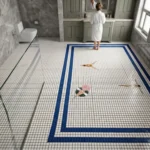
Because individual tiles are tiny, mosaic lets you build patterns, borders, insets and even artwork into the floor plane. You can match the shower floor to the wall field tile, create a contrasting “rug” effect, or use a pebble mosaic for a spa-like, natural-stone feel.
Material Selection for Shower Floors
Not every mosaic material belongs on a shower floor. Here is a comparison of the four realistic options.
| Material | Slip Performance | Water Absorption | Durability | Best For | Typical Cost (installed) |
|---|---|---|---|---|---|
| Porcelain mosaic | Excellent (DCOF ≥ 0.42 achievable) | < 0.5% | Highest, frost-proof | Primary shower floors | $15–25 / sq ft |
| Glass mosaic | Good (depends on finish; matte/frosted best) | ~0% | High, non-porous | Accents, borders, feature floor | $20–50 / sq ft |
| Natural stone pebble | Very good (natural texture) | Variable (needs sealing) | Medium–high | Spa-style floors | $18–45 / sq ft |
| Ceramic mosaic | Good | 3–7% | Medium | Budget floors | $10–25 / sq ft |
Porcelain Mosaic — The Workhorse
Porcelain is the default recommendation for a shower floor. It absorbs less than 0.5% water, is highly resistant to wear and chemicals, and is manufactured with controlled slip resistance. Look for porcelain mosaic rated with a Dynamic Coefficient of Friction (DCOF) of 0.42 or greater when wet, as required by ANSI A137.1/A326.3 for level interior floors expected to be walked on when wet. Matte, textured and “grip” finishes outperform polished surfaces.
Glass Mosaic — Beauty With Caveats
Glass mosaic is fully non-porous and stain-proof, which makes it very easy to clean. However, smooth or polished glass can be slippery when wet, so on a shower floor choose frosted, matte or “anti-slip” textured glass finishes. Glass is also harder to cut cleanly, so installation labor runs slightly higher. Many designers use glass mosaic as a decorative border or feature inset within a porcelain field rather than for the entire floor.
Natural Stone Pebble — The Spa Look
Pebble mosaic (river rock mounted on mesh) delivers the strongest spa aesthetic and excellent natural grip because of its irregular, rounded texture. The trade-offs: stone is porous and must be sealed on a regular schedule (annually for most showers), and pebble floors are slightly less comfortable underfoot than flat tile. Choose flat-cut pebbles rather than full domes for better foot comfort and easier cleaning.
Ceramic Mosaic — The Budget Option
Ceramic mosaic is less dense than porcelain and absorbs more water, so it is less durable in a constantly wet environment. It is acceptable for a guest or secondary bathroom on a tight budget, but porcelain is the better long-term value.
Safety Standards: What the Numbers Mean
When specifying a shower floor, you will see several slip-resistance ratings. Understanding them prevents a costly, dangerous mistake.
- DCOF (Dynamic Coefficient of Friction): The modern standard. Measured using a wet, rubber-soled sensor per ANSI A326.3. For a level, wet, barefoot-traffic surface such as a shower floor, specify DCOF ≥ 0.42.
- SCOF (Static Coefficient of Friction): The older standard. A wet SCOF of 0.60 or higher was the long-standing requirement. Many manufacturers still list SCOF; treat it as a secondary reference.
- R-rating (DIN 51130): A German ramp-test rating from R9 (lowest) to R13 (highest). For a wet barefoot shower area, look for R10 or R11 minimum; R11–R12 for pool-adjacent wet zones.
Rule of thumb: more grout joints + textured tile finish + smaller tile format = safer shower floor. This is why mosaic is inherently the safest choice.
Design Ideas for Mosaic Shower Floors
1. Penny Round
Classic 1-inch circular tiles create a dense grid of grout lines and a vintage look. Penny round is available in porcelain, ceramic and glass. It provides excellent traction and hides minor installation imperfections well.
2. Hexagon
Hexagonal mosaic (typically 1–2 inch) offers a modern, geometric aesthetic while retaining plenty of grout joints. Hexagon in a light porcelain with a contrasting grout color is a current favorite for contemporary bathrooms.
3. Pebble / River Rock
Flat-cut pebble mosaic in grey, black or mixed earth tones turns the shower floor into a natural feature. Pair with a linear drain for a seamless, spa-like plane.
4. Linear / Brick Mosaic
Long, narrow tiles (e.g., 1×2 inch) laid in a brick pattern give directional interest and work beautifully with linear drains, where the tile orientation can guide water flow visually toward the drain.
5. Feature Inset and Borders
Run a field of matte porcelain mosaic, then inset a band of glass or metallic mosaic as a border or a centered “rug.” This gets you the durability of porcelain with the visual punch of glass, at a lower total cost than an all-glass floor.
Installation Essentials (Get These Right or Fail)
Shower floor failures are almost always installation failures, not material failures. Here are the non-negotiable steps per TCNA guidelines, detailed in our mosaic installation tutorial.
1. Slope the Substrate
The mortar bed (or pre-sloped foam pan) must slope a minimum of 1/4 inch per foot toward the drain. This slope is built into the substrate — it is not created by the tile. On a proper bed, the mosaic tiles simply follow the slope.
2. Waterproof Before You Tile
A waterproofing membrane (sheet membrane, liquid-applied membrane, or a traditional hot-mop/PVC pan liner) must be installed and flood-tested before any tile is set. The tile and grout are the wear layer, not the waterproofing. Never rely on grout to keep water out.
3. Use a Polymer-Modified Thin-Set
For a wet area, use a polymer-modified thin-set mortar meeting ANSI A118.4 (or A118.15 for large-and-heavy tile). For glass mosaic, use a white thin-set (to avoid shadowing) and one the glass manufacturer approves. Always back-butter or fully collapse the ridges to achieve at least 95% coverage on a shower floor.
4. Grout With Epoxy or a High-Performance Cement Grout
For a shower floor, epoxy grout is the premium choice — it is stain-proof, waterproof and never needs sealing. A high-performance cement grout with a latex/polymer additive is an acceptable alternative but must be sealed. Choose a grout color carefully: light grout on a floor will show staining over time; mid-tone and darker grouts are more forgiving.
5. Seal Natural Stone (Not Porcelain or Glass)
Porcelain and glass do not need sealing. Natural stone pebble and any cement-based grout do. Seal the stone before grouting (to prevent grout haze bonding) and re-seal on a schedule.
Cost Guide: What a Mosaic Shower Floor Really Costs
Costs below are typical U.S. figures for material plus professional installation, as of 2026.
| Shower Floor Scope | Materials | Labor | Total |
|---|---|---|---|
| Same pan, glass mosaic feature | $400–800 | $500–800 | $900–1,600 |
| Pebble stone, spa-style | $350–700 | $500–800 | $850–1,500 |
| Custom pattern / inset design | $600–1,500 | $700–1,200 | $1,300–2,700 |
Material runs $10–50 per square foot depending on the mosaic; labor typically $8–15 per square foot for a standard mosaic floor, more for pebble and glass because they are slower to set and cut.
Maintenance and Longevity
A properly installed mosaic shower floor should last the life of the bathroom — 20+ years for porcelain, and indefinitely with re-sealing for stone. Keep it that way with simple habits:
- Daily/weekly: Squeegee the floor after the last shower of the day; this removes the soap film and hard-water minerals that cause dulling and mildew. Clean weekly with a pH-neutral tile cleaner — never acid or abrasive cleaners, which etch stone and dull glass.
- Grout care: For cement grout, re-seal every 1–2 years. For epoxy grout, no sealing is ever required. Address any cracked or missing grout immediately to prevent water intrusion.
- Ventilation: Run the exhaust fan during and for 30 minutes after every shower to control humidity, which is the root cause of mildew.
- Stone re-sealing: Test stone porosity annually with the water-drop test (a drop should bead on the surface). If it darkens and soaks in, it is time to re-seal.
Frequently Asked Questions
Is mosaic tile safe on a shower floor?
Yes — it is the safest common option because the many grout joints provide wet traction. Specify porcelain with DCOF ≥ 0.42 for best results.
What size tile is best for a shower floor?
2-inch or smaller. Larger tiles cannot conform to the drain slope and provide far less slip resistance.
Do I need to seal a mosaic shower floor?
Only if it is natural stone or has cement-based grout. Porcelain and glass tile, and epoxy grout, require no sealing.
Glass or porcelain for a shower floor?
Porcelain for the field (durability + grip); glass for accents and borders. If you want an all-glass floor, choose a matte or anti-slip textured finish.
Why does a shower floor need to be waterproofed separately?
Because grout and tile are not waterproof — they are a wear layer. The waterproofing membrane underneath is what actually keeps water out of the structure.
Why Choose BiliTiles for Your Mosaic Shower Floor
BiliTiles manufactures mosaic tile at our own factory, which means designer-grade materials at direct-supply pricing, with no middlemen. We offer:
- 200+ glass colorways and 50+ natural stone varieties, so the shower floor can be matched precisely to your wall tile and overall palette.
- Porcelain, glass, stone and pebble mosaics in penny round, hexagon, brick and custom formats.
- Custom patterns, insets and borders produced to your exact design and dimensions.
- Factory-direct pricing and technical support — we help you specify the right slip rating, thin-set and grout for a wet environment.
Conclusion
The mosaic tile shower floor is the rare product that is simultaneously the safest, most functional and most beautiful choice for the wettest surface in your home. The keys are choosing the right material (porcelain with DCOF ≥ 0.42 as the field, glass or stone as accents), getting the slope and waterproofing right, and grouting with epoxy or a high-performance sealed cement grout. Do those things and your shower floor will look stunning and perform flawlessly for decades.
Ready to specify your shower floor? Contact BiliTiles today for samples, custom patterns and a direct factory quote.