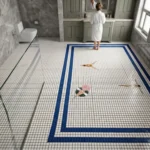
Mosaic tile flooring has been a hallmark of luxury architecture for over 4,000 years — from the intricate pebble floors of ancient Greece to the glass-smalti masterpieces of Byzantine basilicas. Today, the global mosaic tile market is projected to reach $16.2 billion by 2030, driven by demand from hospitality, high-end residential, and commercial renovation sectors. But mosaic flooring isn’t just about aesthetics. It’s a complex intersection of material science, installation engineering, and design strategy that requires careful planning.
This guide covers everything you need to know before specifying, buying, or installing mosaic tile flooring — from material selection to real-world cost data.
1. What Makes Mosaic Flooring Different from Standard Tile
Mosaic tiles are fundamentally different from large-format ceramic or porcelain tiles in three ways:
Size and Format. Mosaic tiles are typically 20mm × 20mm (¾”) or smaller, mounted on mesh-backed sheets (usually 300mm × 300mm, or 12″ × 12″). Each sheet contains anywhere from 144 to 900 individual tesserae, depending on tile size.
Grout Joint Density. A standard 12″ × 24″ porcelain floor tile might have 20 linear feet of grout joints per 100 sq ft. A ¾” mosaic floor has roughly 480 linear feet in the same area — 24 times more. This has enormous implications for slip resistance, maintenance, and installation labor.
Substrate Demands. Because mosaics distribute load across thousands of small tiles rather than a few large ones, they demand a perfectly flat substrate. Any deflection exceeding L/360 (the standard for ceramic tile) will telegraph through the finished surface as cracking grout lines or popped tesserae.
2. Material Selection: A Decision Matrix
The material you choose determines not just appearance but durability, slip coefficient, maintenance needs, and cost. Here’s a practical comparison:
| Material | Slip Resistance (DCOF) | Water Absorption | Indoor/Outdoor | Cost per sq ft (Material Only) |
|---|---|---|---|---|
| Porcelain Mosaic | ≥0.42 (ADA compliant) | <0.5% | Both | $8–$25 |
| Glass Mosaic | 0.30–0.45 | <0.1% | Indoor primarily | $12–$40 |
| Marble Mosaic | 0.30–0.50 (honed) | 0.2–2% | Indoor | $15–$60 |
| Granite Mosaic | ≥0.60 | <0.4% | Both | $12–$35 |
| Travertine Mosaic | 0.35–0.50 (honed) | 1–5% | Indoor | $10–$30 |
| Pebble Mosaic | ≥0.60 | Varies | Both | $8–$20 |
| Ceramic Mosaic | ≥0.42 | 0.5–3% | Indoor | $5–$15 |
Key insights from the field:
- Porcelain is the workhorse for commercial flooring. Through-body color means chips and scratches don’t show white bisque underneath. It’s frost-proof, making it suitable for exterior entryways and pool decks.
- Glass offers unmatched color depth and light reflection, but it’s inherently slippery when wet. For bathroom floors, specify glass mosaics with a textured or frosted surface — a polished glass floor is a liability.
- Marble provides natural veining that no digital printing can replicate, but it etches on contact with acidic substances (wine, citrus, vinegar-based cleaners). Honed finishes hide etching; polished finishes amplify it.
- Pebble mosaics deliver the highest slip resistance and are ideal for wet-room floors and shower pans, but they’re less comfortable under bare feet and trap more dirt in the irregular grout lines.
3. Design Patterns That Define a Space
Mosaic flooring patterns fall into six archetypes:
Geometric Grids
Clean, repeating shapes — hexagons, chevrons, basketweave — in 2-3 colors. Best for modern and transitional interiors. A black-and-white hexagon mosaic floor is the classic Victorian entryway pattern, and it’s still one of the highest-ROI flooring investments for period homes.
Medallions and Centerpieces
A circular or oval focal point, typically 36″–72″ in diameter, set into a field of simpler tile. Medallions originated in Roman villas and remain the signature feature of luxury hotel lobbies. A waterjet-cut marble medallion with brass inlay can cost $3,000–$15,000 for the medallion alone, but it transforms a 500 sq ft entryway from ordinary to memorable.
Borders and Runners
A defined band of contrasting mosaic — typically 4″–12″ wide — framing a room’s perimeter or creating a visual corridor. Used extensively in restaurant dining rooms and hotel hallways to guide foot traffic while adding decorative rhythm.
Field Mosaics
Full-coverage mosaic across an entire floor area. This is the most labor-intensive option but creates the most dramatic impact. A 200 sq ft bathroom with full marble mosaic flooring can take 5–7 days for a single installer.
Mixed-Media Compositions
Combining materials (marble + glass + metal) in a single floor design. Trend in luxury retail and high-end residential. The challenge is differential expansion rates — glass and metal expand at different rates under thermal load, which requires flexible adhesives and movement joints.
Gradient and Ombré
A single tile shape graduating through 4–8 color tones. Popular for spa bathrooms, pool surrounds, and wellness centers. Requires careful material sourcing to ensure color transitions read as intentional rather than patchy.
4. Installation: The Non-Negotiables
Mosaic floor installation is more demanding than standard tile. Here are the technical details that separate a 20-year floor from a 2-year failure:
Subfloor Preparation
The subfloor must be flat to within 1/8″ over 10 feet (3mm over 3m). For concrete slabs: grind high spots, fill low spots with self-leveling underlayment. For wood subfloors: minimum 1-1/8″ total thickness (two layers), screwed every 6″, with an uncoupling membrane (Schluter Ditra or similar) separating the wood from the tile assembly.
Adhesive Selection
For mosaics, always use a polymer-modified thin-set mortar rated for the substrate type. The key specification is that the mortar must be mixed to a consistency that prevents it from oozing up through the grout joints — this is the #1 installer mistake with mosaics, and it turns a 1-2 day grouting job into a nightmare. A 3/16″ V-notch trowel is standard for mesh-mounted mosaics.
Grouting
Given the high grout-joint density of mosaic floors, grout selection matters disproportionately:
- Epoxy grout: Impervious, stain-proof, ideal for kitchen and bathroom floors. Cost: 3-4× cement-based grout. Harder to work with (pot life: 45 minutes at 70°F).
- Cement-based grout with polymer additive: Standard choice for most installations. Requires sealing. Available in 40+ colors.
- Urethane grout: Pre-mixed, flexible, good for wood-subfloor installations. Color-consistent but less hard than epoxy.
Joint width for floor mosaics is typically 1/16″–1/8″ (1.5mm–3mm). Wider joints provide more slip resistance but collect more dirt.
Sealing
Natural stone mosaics require impregnating sealer (penetrating, not surface-coating) applied before and after grouting. Porcelain and glass mosaics don’t require sealing, though the grout itself should always be sealed on floors.
Movement Joints
TCNA guidelines require movement joints every 20–25 feet in interior tile floors, and at all transitions (perimeter, doorway thresholds, changes in substrate). For mosaic floors, the high grout density actually provides some stress relief, but movement joints are still mandatory — and they should be designed into the pattern, not cut in as an afterthought.
5. Cost Breakdown: What to Budget
Real-world cost data for professionally installed mosaic flooring (US market, 2026):
| Scope | Material ($/sq ft) | Labor ($/sq ft) | Total ($/sq ft) |
|---|---|---|---|
| Porcelain mosaic, standard pattern | $8–$18 | $12–$20 | $20–$38 |
| Marble mosaic, standard pattern | $15–$40 | $15–$22 | $30–$62 |
| Glass mosaic, bathroom floor | $12–$35 | $18–$25 | $30–$60 |
| Custom waterjet medallion + field tile | $25–$80 | $25–$40 | $50–$120 |
| Pebble mosaic, shower floor | $8–$18 | $15–$22 | $23–$40 |
What drives labor cost up:
- Pattern complexity (a herringbone mosaic takes roughly 40% more time than a straight-set grid)
- Subfloor condition (leveling a wavy slab can add $3–$8/sq ft before tile work begins)
- Room geometry (lots of cuts around curved walls, toilet flanges, and door jambs)
- Epoxy grout (adds $3–$5/sq ft to the grouting phase alone)
For a typical 60 sq ft bathroom floor with porcelain hexagon mosaic: budget $1,800–$2,500 all-in. For a 300 sq ft hotel lobby with a custom marble medallion: budget $18,000–$40,000.
6. Where Mosaic Flooring Delivers the Highest ROI
Entryways and Foyers. First impressions are disproportionately valuable. A mosaic entry floor signals quality before the visitor takes three steps. The ROI here is perceptual — it raises the perceived value of the entire property.
Hotel Lobbies. Major chains (Marriott, Hilton, Four Seasons) consistently specify mosaic lobby floors in premium properties. The reason: a mosaic floor with a custom medallion becomes a photo backdrop. Guests photograph it. It shows up on Instagram and TripAdvisor. It’s essentially free marketing embedded in architecture.
Restaurant Dining Rooms. Mosaic floors handle heavy foot traffic, spilled liquids, and constant chair movement better than hardwood or carpet. A geometric porcelain mosaic in a 1,500 sq ft dining room will look nearly new after 5 years of service, while the same space in hardwood would need refinishing twice.
Bathroom Floors. This is the most common residential application. Mosaic floors in bathrooms provide inherent slip resistance (thanks to the grout joint density), are impervious to water, and add a custom, high-end feel that buyers notice.
Pool Decks and Surrounds. Porcelain mosaics are frost-proof, UV-stable, and offer slip resistance exceeding ADA requirements. The critical specification here is DCOF ≥ 0.60 for wet areas, which unglazed porcelain and pebble mosaics achieve easily.
7. Maintenance: What Owners Need to Know
Mosaic floors with cement-based grout require:
- Daily: Dry sweeping or vacuuming (no beater bar)
- Weekly: Damp mopping with pH-neutral cleaner (never vinegar or acid-based cleaners on natural stone)
- Quarterly: Inspection of grout lines for cracks or discoloration
- Annually: Re-sealing of grout (and stone, if applicable)
Epoxy-grouted floors eliminate the annual sealing step and resist staining far better, making them the preferred choice for commercial kitchens, restaurant floors, and high-traffic bathrooms.
One under-discussed maintenance factor: grout color choice. Light-colored grout on a floor will show dirt within months and require frequent deep cleaning. Medium-to-dark grout (charcoal, taupe, warm gray) hides traffic patterns and looks cleaner longer. This is not an aesthetic preference — it’s a maintenance decision.
8. Procurement: Factory-Direct vs. Retail
If you’re ordering mosaic flooring for a commercial project or a whole-home renovation, the economics of factory-direct sourcing are compelling:
- A retail showroom marks up mosaic tile 2–3× over wholesale
- A factory-direct supplier (especially from production centers like Foshan, China) can deliver custom patterns, specified materials, and exact color matching at 30–50% less than retail
- Lead time is the trade-off: custom orders typically require 4–8 weeks production plus shipping, versus off-the-shelf retail availability
For standard patterns and materials (hexagon porcelain, Carrara marble mosaic), retail is faster and sufficient. For custom designs, large quantities, or projects where budget matters more than lead time, factory-direct procurement is the smarter path.
Conclusion
Mosaic tile flooring is not a budget option. But evaluated as a 20–30 year investment, it outperforms wood, carpet, vinyl, and even large-format porcelain in durability, maintenance cost, and aesthetic longevity. The key decisions — material, pattern, grout type, and installer quality — determine whether you get a floor that looks better with age or one that starts deteriorating on day one.
Plan the substrate. Choose the right grout. Don’t cut corners on installation. The tiles will outlast all of us — it’s the substrate and the grout that determine how they look on the journey.
*For custom mosaic flooring specifications, material samples, or project consultation, contact the BiliTiles design team.*
Keywords targeted: mosaic tile flooring, mosaic floor installation, mosaic flooring cost, mosaic floor design ideas, porcelain mosaic flooring, marble mosaic floor, mosaic bathroom floor, mosaic entryway floor, commercial mosaic flooring, pool deck mosaic.