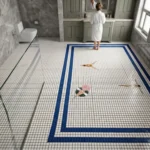
Mosaic tile countertops are having a quiet renaissance. What was once dismissed as a dated 1970s bathroom vanity look has been reclaimed by designers who understand one thing: few surfaces offer the same combination of durability, color depth, and one-of-a-kind visual texture. A mosaic countertop is not a mass-produced slab — it is thousands of individual pieces, each catching light at a slightly different angle, creating a surface that reads as bespoke the moment you walk into the room.
This guide covers everything you need to know before committing to a mosaic countertop: which materials actually hold up under daily use, what substrate and installation standards prevent failure, how edges are finished, what it costs, and how to maintain the surface so it looks new for decades.
Why Choose a Mosaic Countertop
Mosaic countertops earn their place in kitchens, bathrooms, and commercial bars for reasons that go beyond aesthetics.
Design flexibility. A slab is limited to whatever the quarry or kiln produced. Mosaic lets you mix materials, gradients, and custom patterns — a client logo set into a bar top, a gradient of glass that shifts from deep blue to white, a field of tesserae matched exactly to a brand color.
Targeted durability. You are not forced to accept one material’s weaknesses. Mosaic lets you use glass where you need stain resistance, porcelain where you need abrasion resistance, and natural stone only where its look justifies the maintenance.
Repairability. If a single tile chips or a section is damaged, you replace the affected tesserae and re-grout — not the entire countertop. This is a real cost advantage over solid surface or stone slabs over a 20-year horizon.
Small-batch feasibility. Because mosaic is assembled from small units, it can be produced economically for a single kitchen or a small commercial run, without the minimum-order and cutting-waste problems of large-format slabs.
Sustainability. Remnant glass and stone that would otherwise be discarded can be cut into tesserae, reducing material waste on premium stone.
Material Selection: What Actually Works on a Countertop
Not every mosaic material belongs on a horizontal, food-contact, knife-adjacent surface. Here is the honest assessment.
| Material | Countertop Suitability | Abrasion Resistance | Stain/Heat Notes | Typical Installed Cost (per sq ft) |
|---|---|---|---|---|
| Porcelain | Excellent | High (PEI 4–5 required) | Non-porous, highly stain- and heat-resistant | $30–$80 |
| Ceramic | Good (decorative bands only) | Moderate | Glaze can chip at edges | $20–$50 |
| Marble | Fair | Low — etches with acid | Porous, acid-sensitive (lemon, vinegar, wine etch) | $50–$150 |
| Granite | Very good | High | Dense, acid-resistant, needs periodic sealing | $55–$160 |
| Travertine | Fair | Low–moderate | Porous, acid-sensitive, needs frequent sealing | $40–$110 |
| Metal (stainless/bronze) | Good (accent only) | High | Conducts heat, shows scratches | $70–$200 |
The glass tile rule. For a working kitchen counter, choose glass or porcelain tesserae with a PEI rating of 4 or higher and a DCOF rating appropriate to the area. Avoid glossy glass on high-traffic food-prep zones — a honed or frosted finish hides scratches and daily wear far better.
The stone caveat. Natural stone mosaic looks stunning as a decorative border or inset, but as a full work surface it demands the discipline of immediate spill cleanup and annual sealing. If the client will not commit to maintenance, steer them to porcelain that convincingly replicates stone.
Metal accents. Use metal tesserae sparingly — as a border, inset band, or logo. Full metal surfaces are unforgiving of scratches and every fingerprint shows.
Design Ideas by Application
Kitchen counters. A field of matte porcelain mosaic in a neutral tone, with a single contrasting glass border 40–60 mm from the edge, reads as contemporary without being busy. For a statement island, a full-glass gradient mosaic is the single most photographed surface in the room.
Bathroom vanities. This is the classic application and still the best value. Glass mosaic in the wet zone, porcelain on the deck, with an integrated tesserae sink backsplash. The small format handles curves around vessel sinks and integral basins far better than any slab. For the walls below and around the vanity, a matching mosaic wainscot ties the room together.
Bar and café tops. Commercial bars favor porcelain or glass mosaic because they tolerate spilled liquor, citrus, and hot espresso without etching or staining. Branding can be set directly into the field as a logo mosaic.
Outdoor kitchens. Only porcelain and granite survive freeze-thaw and UV. Confirm a frost-proof rating (ISO 10545-12) and use a cementitious grout rated for exterior use. Avoid glass outdoors in climates with large temperature swings — thermal shock is the leading cause of outdoor glass failure.
Edge profiles and the “mosaic lip.” The single biggest technical question is the edge. Mosaic sheets are ~6–8 mm thick, so the front edge must be built up. Options: a metal trim profile (Schluter or equivalent) for a clean contemporary line; a bullnose tile border; or a double-layer substrate that lets the mosaic wrap the edge for a seamless hand-built look.
Substrate and Installation Requirements
A mosaic countertop is only as good as its substrate. Failure almost always traces to a substrate or adhesive shortcut, not to the tile itself.
Substrate. Use cement board or a properly sealed plywood base with a waterproof membrane. For a kitchen counter, the substrate must be rated for moisture and dimensionally stable. Tile directly over raw plywood will telegraph movement and crack the grout within months.
Adhesive. A polymer-modified thin-set (meeting ANSI A118.4 or A118.15) is standard. For glass tile, use a white thin-set and back-butter each sheet to avoid shadowing and to ensure full coverage — a minimum 95% coverage on a food-prep surface is the industry benchmark.
Layout. Dry-lay every sheet and reconcile sheet-to-sheet joints before committing adhesive. Mosaic sheets are notorious for visible seams; the fix is to adjust grout joints at the sheet boundary rather than forcing alignment within the sheet.
Grouting. Use epoxy grout on kitchen counters — it is non-porous, stain-proof, and does not need sealing. Sanded grout is acceptable only for joints over 1/8 inch. On food-contact surfaces, epoxy is the defensible default.
Sealing. Glass and porcelain do not need sealing. Natural stone mosaic must be sealed before grouting (to prevent grout staining the face) and re-sealed annually. Test with the water-drop method: if a drop of water darkens the stone within 30 minutes, it is time to reseal.
Cost: What a Mosaic Countertop Actually Costs
Mosaic countertops occupy a wide price band because material and labor vary enormously.
| Component | Economy | Mid-Range | Premium |
|---|---|---|---|
| Labor | $15–$30/sq ft | $30–$50/sq ft | $50–$100+/sq ft (custom pattern) |
| Total installed | $35–$70/sq ft | $70–$130/sq ft | $130–$300+/sq ft |
A realistic example. A standard 30 sq ft kitchen counter in mid-range glass mosaic runs roughly $2,100–$3,900 installed. The same footprint in premium custom gradient glass or hand-set stone can reach $6,000–$9,000. The labor premium for mosaic over slab is real — expect installation to be 1.5–2× the cost of large-format tile because of sheet alignment, edge work, and grouting time.
Where the value is. Mosaic makes the strongest economic case on smaller, irregular, or highly visible surfaces — a bathroom vanity, a bar top, an island front, a backsplash band — where a slab would generate heavy cutting waste. On a large run of standard kitchen counter, slab or large-format porcelain is usually more cost-efficient.
Maintenance and Longevity
Daily. Wipe with a pH-neutral cleaner and a soft cloth. Avoid abrasive pads on glass and metal. On stone, clean spills immediately — acids etch within minutes.
Weekly. Clean grout lines with a soft brush; on epoxy grout a damp cloth is sufficient.
Quarterly. On stone, verify the seal with the water-drop test and reseal as needed.
Annually. Inspect grout for hairline cracks and the edge profile for separation. Re-caulk the counter-to-backsplash joint with a color-matched silicone.
Expected life. A well-installed porcelain or glass mosaic countertop should perform for 25+ years with routine care. The grout, not the tile, is the wear item — and epoxy grout extends that interval dramatically.
Common Mistakes to Avoid
- Choosing glossy glass for the main prep surface — it shows every scratch and water spot.
- Grouting before sealing porous stone — grout pigment permanently stains the face.
- Using unsanded grout on joints over 1/8 inch — shrinkage cracks follow.
- Skipping back-buttering on glass — telegraphs adhesive ridges and leaves voids.
- Laying tile directly over raw plywood — movement cracks the grout within months.
- Ignoring sheet seams — the most visible defect in finished mosaic work.
- Using natural stone on a kitchen island without a maintenance commitment — the first lemon or red-wine spill etches permanently.
FAQ
Is a mosaic countertop durable enough for a kitchen?
Yes, provided you select porcelain or glass with a PEI 4+ rating, use epoxy grout, and install over a proper substrate. Mosaic is not inherently fragile — material choice determines durability.
Does mosaic grout get dirty easily?
Cementitious grout does; epoxy grout does not. On food-prep surfaces, epoxy grout is the standard solution and eliminates the staining problem almost entirely.
Can mosaic countertops be repaired?
Yes — this is a key advantage. Individual tesserae can be removed and re-set, and grout can be repaired or recolored without replacing the whole surface.
Is mosaic more expensive than slab?
Per square foot, labor is higher. On small or irregular surfaces where slab waste is high, mosaic is often cheaper overall. On large standard counters, slab wins.
Do mosaic countertops need sealing?
Glass and porcelain do not. Natural stone does — before grouting and annually thereafter.
Working with BiliTiles
BiliTiles has supplied custom mosaic for kitchens, vanities, and commercial bar tops for over 15 years, directly from our Foshan factory. We offer 200+ glass colorways, 50+ natural stone varieties, and custom gradient, logo, and pattern programs with no middleman markup. For countertop projects we provide material selection guidance, color-matched grout recommendations, and technical support through installation.
Conclusion
A mosaic countertop is a deliberate choice: it trades the seamless uniformity of a slab for a surface with texture, color depth, and repairability that no slab can match. The outcome depends almost entirely on two decisions — choosing the right material for the use, and insisting on a proper substrate, adhesive, and grout. Get those right, and you have a countertop that is both a working surface and a signature piece, built to last decades rather than a single trend cycle.
Contact BiliTiles to discuss your countertop project, request material samples, or receive a specification tailored to your space.