White Peel and Stick Mother of Pearl Shell Mosaic Tile (20mm): An Iridescent Backsplash You Can Install Without a Trowel
Mother of pearl is the rare surface that looks expensive in a way that is hard to fake. Where glass reflects and ceramic sits still, nacre shifts. Tilt a sheet of these twenty-millimetre shell squares and the colour moves through cream, blush, mint and a cool pearl grey, because the iridescence comes from the physical structure of the shell rather than from a printed pigment. It is the same optical trick that makes an oyster shell flash at the beach, brought indoors and cut into a precise grid.
The peel-and-stick format is the practical half of the story. This is a two-millimetre sheet with an adhesive backing, designed for interior walls where you want the look of a hand-set pearl mosaic without the dust, the thin-set and the curing time. For a kitchen backsplash, a vanity wall, a reception accent or a rental you are not allowed to demolish, it changes what is possible on a weekend rather than a fortnight.
White Peel and Stick Mother of Pearl Shell Mosaic Tile 20mm
Mother of pearl · 300 × 300 mm sheet · 2 mm thin · glossy nacre · peel-and-stick, sold by the sheet
The Sheet, Up Close
On a white background the real sheet shows a tight grid of square shell chips, roughly twenty millimetres each, with a hairline gap between them. Fifteen chips span the three-hundred-millimetre sheet. The surface is the point: every square carries its own direction of growth, so the lustre never repeats. Some chips are almost milk-white, others carry a faint pink or green flash, and a few show the natural striations of the shell. Because the material is genuine mother of pearl, no two sheets are identical, and that variation is a feature to design around rather than a defect to hide.
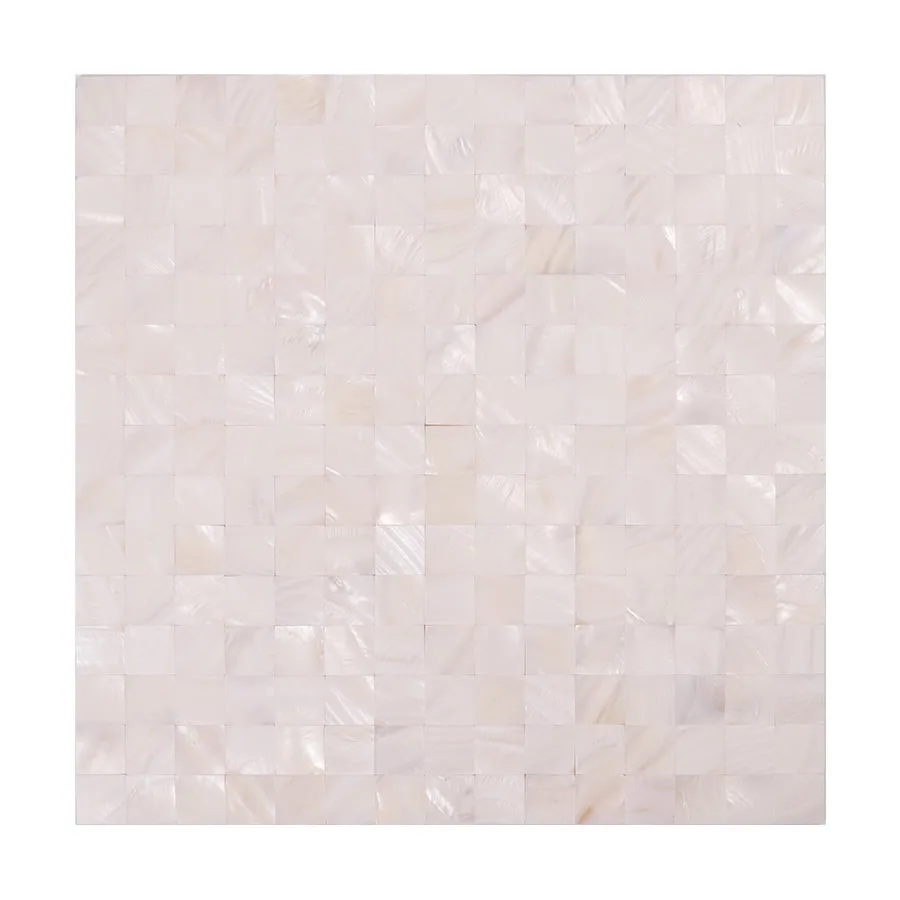
It is a true mosaic, not a printed panel. Each twenty-millimetre square is an individual piece of shell, and the grout line between them is part of the look. Fifteen chips across a sheet is a fine grain: at arm’s length you read individual squares, and from a few metres back they blend into a soft, luminous field. If a visual shows four or five big squares across a backsplash, it has been drawn as oversized tile and the material has been misrepresented.
Dimensions and Specifications
The sheet is three hundred by three hundred millimetres and only two millimetres thick, which is what makes the peel-and-stick format work: thin enough to sit almost flush against a wall, light enough to hold on an adhesive backing. The chip size of twenty millimetres appears in the product name and matches the measured grid. Each box contains thirty sheets, covering 2.7 square metres and weighing 16.5 kilograms.

| Material | Mother of pearl (natural shell) |
| Sheet size | 300 × 300 mm |
| Chip size | ≈ 20 mm square |
| Thickness | 2 mm |
| Finish | Glossy, natural nacre lustre |
| Mounting | Peel and stick (self-adhesive backing) |
| Sold by | Sheet (30 sheets / box, 2.7 m² per box, 16.5 kg) |
| Applications | Interior walls, kitchen backsplashes, vanity walls, dry accent panels (not outdoor, not shower walls, not submerged) |
That last line is the honest boundary of the product, and it is worth stating plainly. Mother of pearl is a natural material and a peel-and-stick sheet is an interior wall product. It is not for outdoor use, not for shower walls, and not for submerged applications such as a pool waterline or a shower floor. Where those conditions exist, specify a glazed ceramic or glass mosaic instead and keep the pearl for the dry, decorated surfaces it was made for.
In a Bathroom: A Vanity Backsplash, Not a Shower
The bathroom is where pearl earns its keep, provided it is used in the right place. In the image below the mosaic forms the vanity backsplash and the lining of a dry recess above the counter, framed in brass. A woman in a champagne robe provides scale. The shell reads as a soft, luminous block of light behind the basin, and the twenty-millimetre grain stays fine and legible. This is a dry wall, away from the shower spray, which is exactly where a peel-and-stick pearl belongs.
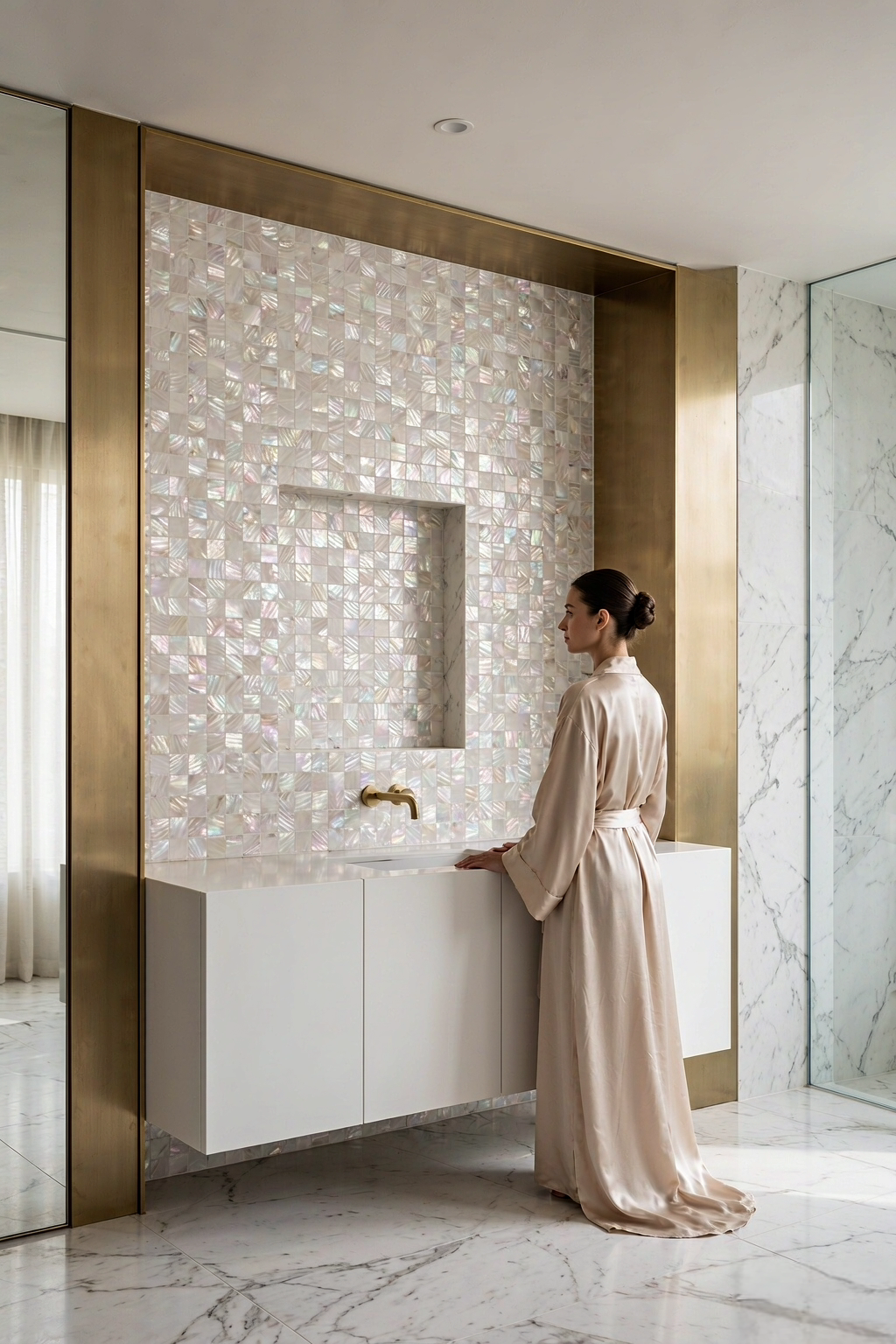
If you want the pearl look inside a shower, use it on a sheltered niche face or a wall outside the spray zone, and treat the wet surfaces with a ceramic or glass mosaic. Trying to force a natural-shell peel-and-stick sheet into a wet wall is the one mistake that will shorten its life dramatically.
In a Lobby or Bar: A Counter With a Glow
In commercial interiors, pearl is a lighting material as much as a surface. Cladding the front of a bar or reception counter in a sixty-centimetre band gives the counter a warm, low-level glow that changes as guests move and the light shifts. Two guests in evening dress show the scale: the squares stay small and the band reads as a crafted, expensive detail rather than a flat panel.
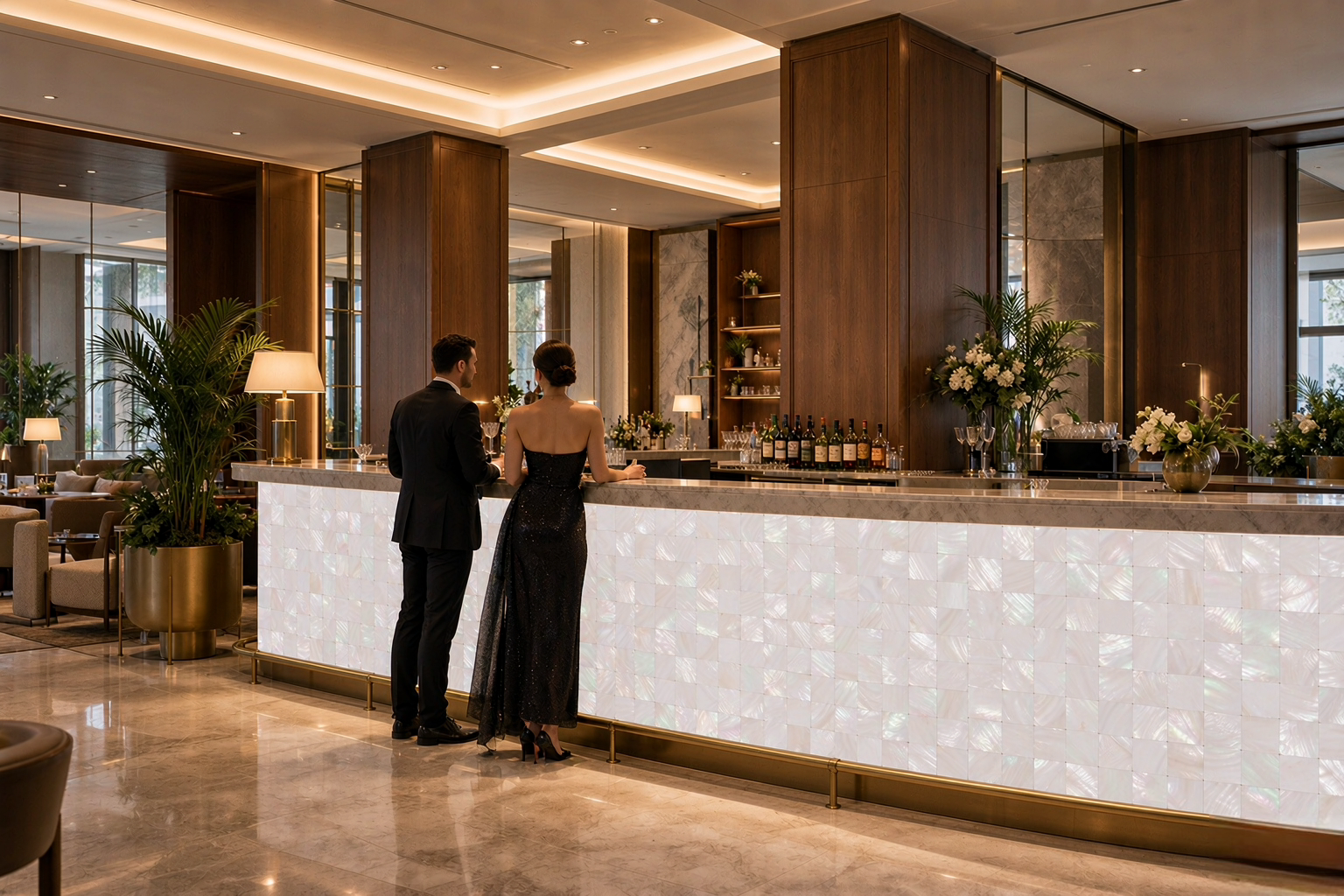
For hospitality, the appeal is speed and reversibility. A peel-and-stick band can be installed in an evening and removed at the end of a season without destroying the substrate, which suits pop-ups, seasonal bars and brand refreshes where a permanent trowel-and-grout job is overkill.
At the Poolside: The Sheltered Wall, Not the Waterline
Poolside is where clients often ask for pearl and where a good supplier has to say no to the obvious version of the request. A submerged waterline is not the place for mother of pearl or for a peel-and-stick sheet. What works, and what the image below shows, is the sheltered interior wall of a poolside cabana: the pearl band sits behind a bar, under a roof, protected from spray, with the pool visible through the open side. You get the resort mood without exposing a natural material to chlorine and constant wetting.
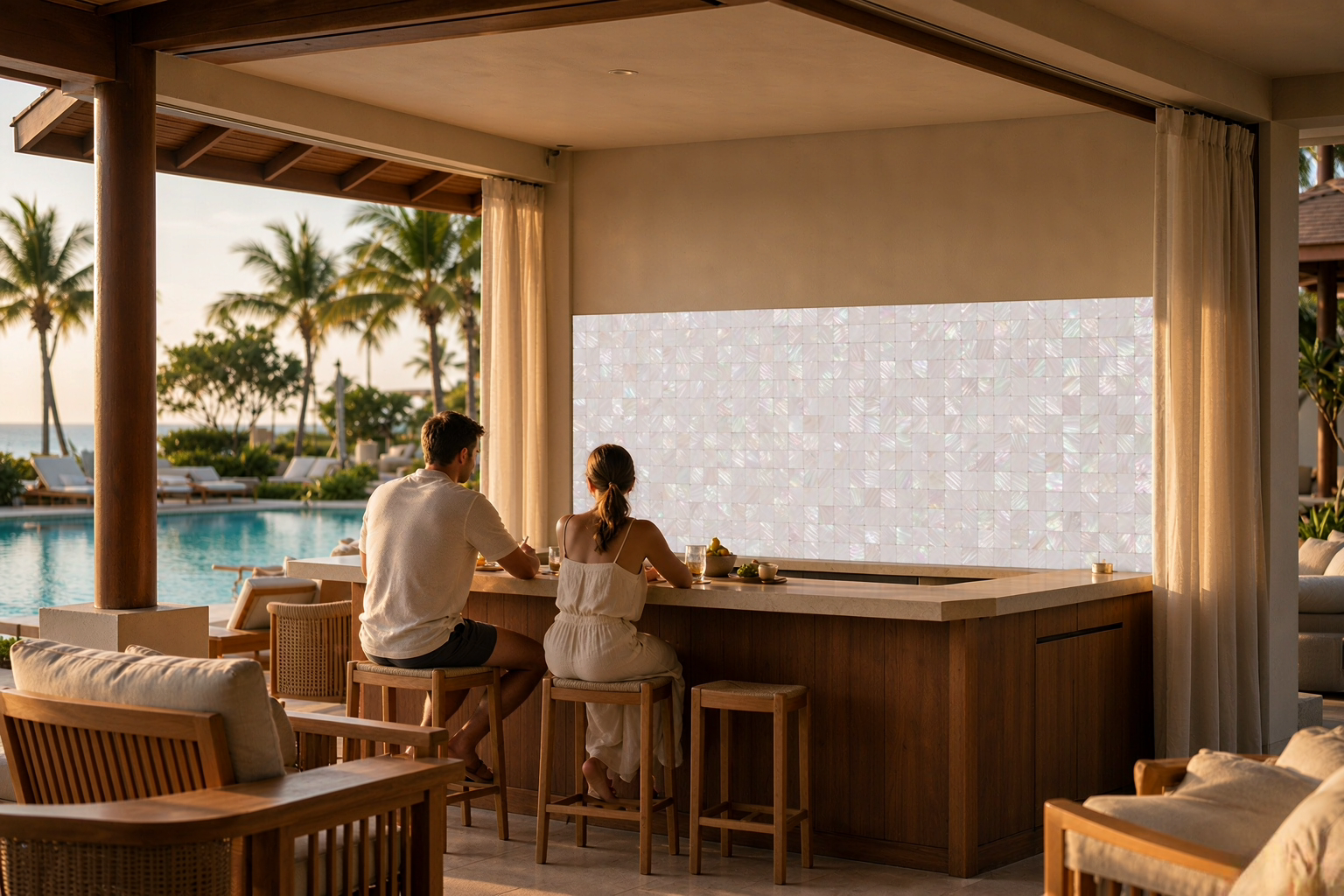
That distinction is worth repeating to a client. Pearl is a dry-area luxury. Used honestly, on sheltered walls and interiors, it lasts and looks extraordinary. Used as a waterline, it fails, and no amount of sealing will make a peel-and-stick shell sheet into a pool material.
Designing With Pearl: Grout, Light, One Focal Surface
Three choices shape how a pearl mosaic reads.
Keep the grout fine and light
A pale, fine grout lets the shell dominate and keeps the grid quiet. A dark grout turns the wall into a graphic checkerboard and fights the iridescence. Because the chips are only twenty millimetres, the grout line should be as narrow as the substrate allows.
Light it softly and from the side
Nacre needs direction to flash. Soft, angled light, whether from a window, a picture light or a diffused sconce, brings out the colour shift. A flat, head-on downlight washes the lustre out and makes the wall look like plain white tile.
Give it one focal surface
Pearl is a highlight material. One backsplash, one bar front, one niche. Spread it across a whole room and the iridescence becomes visual noise; concentrate it and it becomes the detail guests remember.
Factory-Direct From Foshan: Sourcing a Natural Material Honestly
Mother of pearl is a natural material, which makes sourcing and consistency the real challenge. Bilitiles works factory-direct from Foshan, where the shell is sorted, cut and mounted, so a buyer can ask the questions that matter: how uniform is the lustre across a batch, how is the nacre graded, and how consistent is the adhesive backing from sheet to sheet. Factory-direct sourcing is not just about price; with a natural material it is about knowing what you are buying before it reaches the wall.
For a designer or contractor, that also means realistic lead times and the ability to reserve a batch for a project. Pearl varies, and a good factory will help you work with that variation rather than pretend it does not exist.
Specifying for Hospitality and Commercial Projects
Peel-and-stick pearl is a specialist tool in a commercial kit, and it is specified for specific jobs:
- Fast refurbishment. A bar front or vanity wall can be refreshed overnight without demolition or drying time.
- Reversible branding. Seasonal and pop-up spaces can install and remove the material without damaging the substrate.
- Interior, dry walls only. Not outdoor, not shower walls, not submerged; specify ceramic or glass where water is constant.
- Substrate discipline. The adhesive needs a clean, flat, dry surface; a rough or dusty wall will shorten its life.
For the broader picture, our mosaic bathroom design guide and the guide to mosaic art in hotels both show where a material like pearl fits into a scheme without overreaching.
Installation and Care
The whole advantage of peel-and-stick is speed, but speed only works if the wall is right.
- Start with a clean, dry, flat, dust-free surface. Wipe down and let it dry fully; adhesive will not bond to a damp or greasy wall.
- Plan the layout before you peel. Once a sheet touches the wall it grips, so dry-fit and mark your lines first.
- Press firmly from the centre outward, and roll the edges; a hard roller is better than a hand.
- Cut with a sharp utility knife against a straight edge; score and snap for outlets and corners.
- Clean with a soft, damp cloth and a pH-neutral cleaner. Avoid abrasive pads and acidic descalers, which dull the nacre.
In a kitchen, wipe oil splatter promptly with warm soapy water. Pearl is durable as a surface, but it is a natural material and it rewards gentle cleaning.
Frequently Asked Questions
Is this real mother of pearl or a printed imitation?
It is genuine mother of pearl. Each twenty-millimetre square is cut from natural shell, so the iridescence and the fine striations differ from chip to chip. No two sheets are identical.
Can I use it in a shower or around a pool?
No. This is an interior, dry-wall product. It is not for shower walls, outdoor use or submerged applications such as a pool waterline. For wet areas, choose a glazed ceramic or glass mosaic instead.
Where can I see the price and request a sample?
Sizes, factory pricing and a physical sample request are on the White Peel and Stick Mother of Pearl Shell Mosaic Tile 20mm product page.
Can I install it over existing tile?
Only if the existing surface is flat, sound and clean, with no loose edges or deep grout lines. On rough or uneven tile the adhesive cannot make full contact, and the sheet will lift. When in doubt, skim the wall flat first.
Where to Go Next
If you want an interior wall that glows rather than reflects, start with the White Peel and Stick Mother of Pearl Shell Mosaic Tile 20mm for sizes, pricing and a sample. You can explore related shell and pearl formats in the shell and pearl mosaic collection, and for design inspiration read our guide to creating a spa-like bathroom with mosaic.