White Hexagon Ceramic Crackle Mosaic Backsplash Wall Tile: Bright, Quiet and Built for Light
White is the hardest colour in a room to get right. Flat white paint turns grey in shadow; glossy white panels throw glare; cheap white tile looks like a hospital corridor by ten in the morning. A white hexagon crackle mosaic solves the problem differently. Instead of one reflective plane, it gives you hundreds of small glazed surfaces, each tilted a fraction differently from its neighbour, so light is broken up, softened and scattered rather than bounced back at the viewer. The wall stays bright without becoming a mirror, and it keeps a fine, hand-made texture that a printed porcelain slab can only imitate.
This is the quiet counterpart to a dramatic dark mosaic. It is the surface you choose when the room needs light more than it needs a statement, and when the architecture, the joinery or the view should stay the hero. Used as a backsplash or a shower wall, it does the unglamorous work of making a space feel clean, warm and finished, and it does it with a grain you can actually see.
White Hexagon Ceramic Crackle Mosaic Backsplash Wall Tile
Ceramic · 260 × 300 mm sheet · 8 mm thick · glossy crackle glaze · mesh mounted, sold by the sheet
The Sheet, Up Close
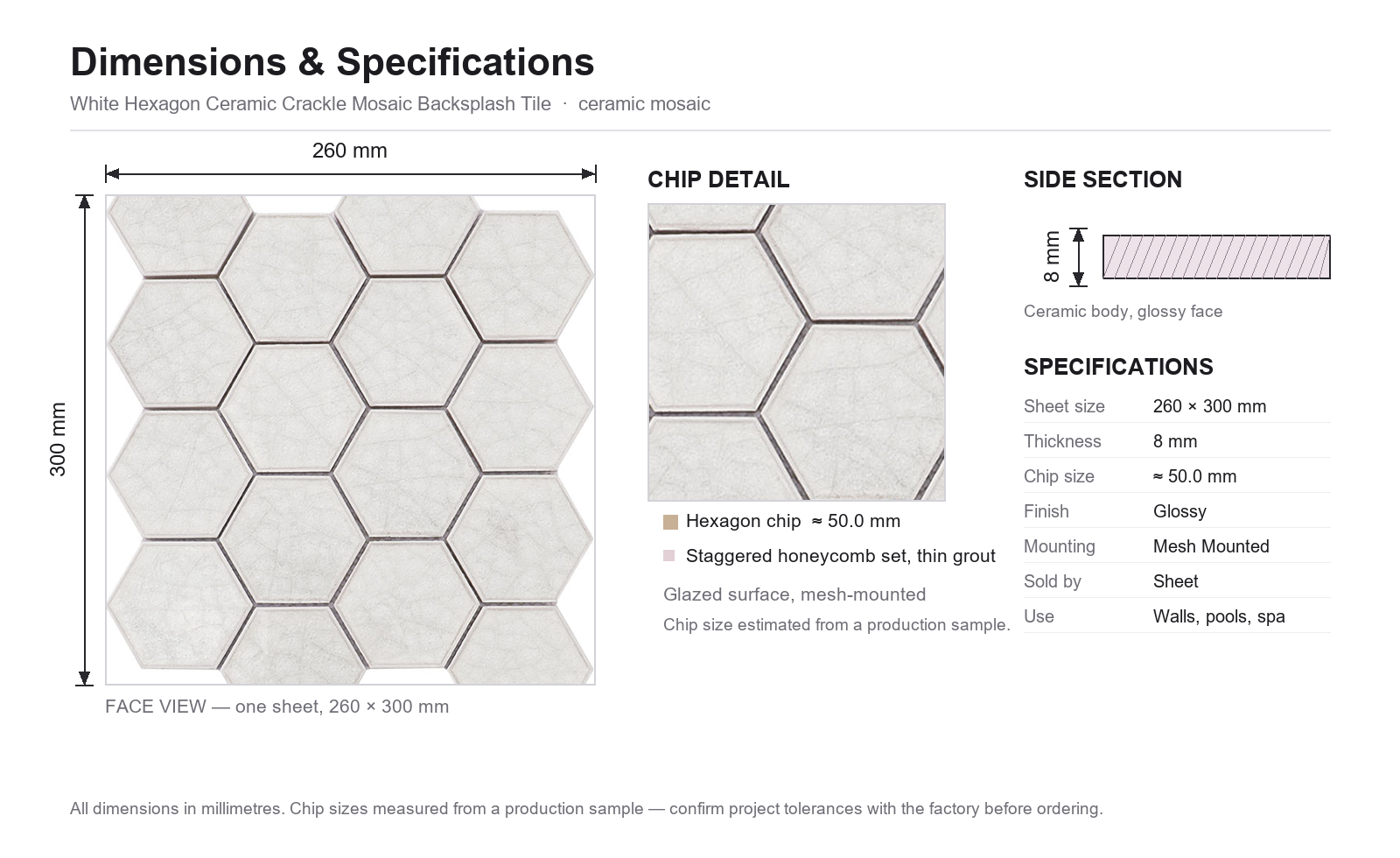
Laid flat on white, the real sheet is deceptively simple: a staggered honeycomb of off-white hexagons, each about fifty millimetres across, separated by a thin, even grout line. Up close the glaze reveals delicate crackle veining and a faint drift toward cool grey in some chips and warm cream in others. That drift is the difference between a wall that looks alive and one that looks printed. The chips are glazed ceramic, not painted glass, so the colour sits under a hard, food-safe, wipe-clean surface.

It is a genuine mosaic rather than a small-format tile. Each hexagon is a separate piece of fired ceramic, bonded to a mesh backing so the sheet can flex slightly and follow the wall. The chip repeat is uniform, and the interest comes from the glaze and the grout, not from mixing sizes. That is exactly what you want in a bright room: a single calm module, repeated, that resolves from a fine honeycomb up close into a soft white shimmer at three or four metres. If a visual shows a handful of giant hexagons across a backsplash, it has been drawn as oversized tile and the material has been misunderstood.
Dimensions and Specifications
The sheet measures 260 by 300 millimetres (10.24 by 11.81 inches) at eight millimetres thick. Chip size is not stated on the product page, so the value below is measured from a production sample and should be confirmed with the factory for tight-tolerance work. One sheet covers about 0.84 square feet.
| Material | Ceramic |
| Sheet size | 260 × 300 mm (10.24 × 11.81 in) |
| Chip size | ≈ 50 mm hexagon (measured from sample) |
| Thickness | 8 mm (0.315 in) |
| Finish | Glossy, crackle glaze |
| Mounting | Mesh mounted |
| Sold by | Sheet (≈ 0.84 sq.ft. per sheet) |
| Applications | Interior and exterior walls, shower walls, backsplashes, spa walls (not shower floors) |
Note the last line. This is a wall mosaic. It is happy on a shower wall, a kitchen backsplash or a spa wall, but it is not specified for shower floors, where slip resistance and point loading demand a different product. If you need a floor, ask the factory for a matching floor-rated option rather than pushing a wall tile into a floor detail.
In a Bathroom: Light That Bounces Back
In the bathroom below, the white hexagon mosaic runs as a full-height panel behind a freestanding tub, with a recessed niche cut into it. The effect is architectural rather than decorative. Because the glaze scatters light, the wall lifts the whole room without glare, and the niche reads as a shadow-box set into a bright field. A woman in a robe provides scale; the hexagons stay small and legible, exactly as they should.

The trick with a white mosaic in a bathroom is contrast. Keep the fixtures and joinery quiet, in stone, oak or brushed metal, and let the wall carry the light. If everything in the room is white and glossy, the mosaic disappears; a little warmth nearby makes it glow.
In a Lobby: A Counter That Reads Clean
White hexagon mosaic also works hard in commercial reception areas, where the brief is usually some version of bright, clean and expensive-looking without being cold. Cladding the front of a stone reception desk in a sixty-centimetre band gives the counter a crisp, tailored base. Two guests at the desk show the scale: the hexagons are small enough to look crafted and large enough to read from across the room.

In a lobby the practical argument is just as strong as the visual one. A white glazed ceramic is easy to wipe down, does not show fingerprints the way brushed metal does, and can be repaired chip by chip if a trolley catches the corner. That combination is why hotel operators keep specifying it for high-touch horizontal bands.
At the Pool: The Waterline, Not the Floor
Used as a pool waterline, the white hexagon mosaic does something the dark version cannot: it disappears into the light. A narrow band between pale coping and turquoise water keeps the edge looking seamless and clean, and the gloss picks up ripples without turning the pool into a mirror. As with the bathroom, the important thing is the grain. The band should show hundreds of small chips, not a few large hexagons.
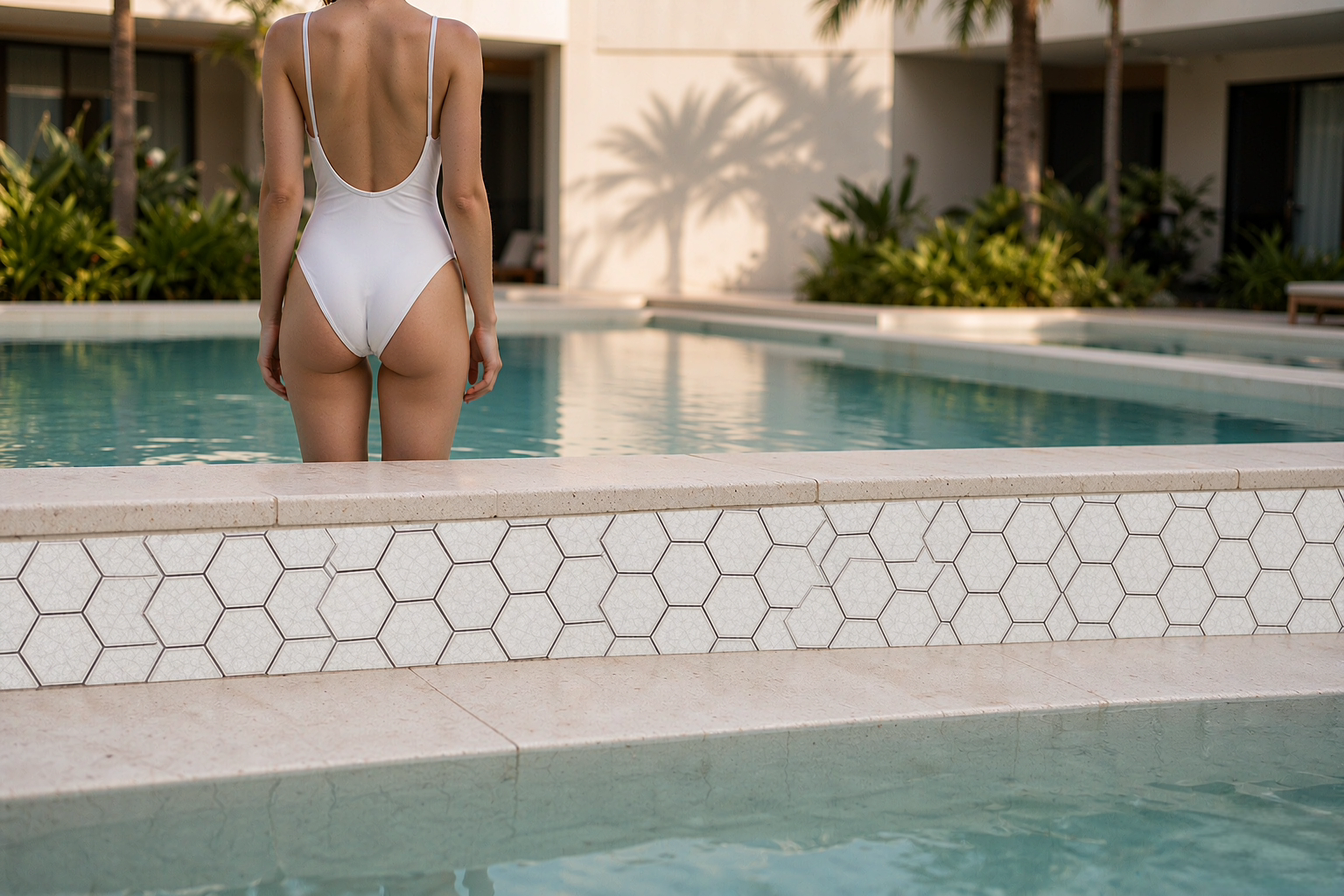
Keep this firmly a wall-and-waterline application. Pool floors and shower floors are a different specification, and a reputable supplier will tell you so rather than sell you the wrong product.
Designing With White Mosaic: Grout, Glare, One Focal Surface
White is unforgiving of sloppy decisions, so three rules do most of the work.
Pick the grout deliberately
A light grey grout keeps the honeycomb crisp and stops the wall from turning into a white blur. A grout matched to the chip makes the mosaic read as a continuous, almost seamless surface, which is calmer but hides the craft. Pure white grout is the riskiest choice: it looks brilliant for a month and then shows every shadow.
Control the glare
Glossy white amplifies light, which is the point, but a hard downlight directly on it can bloom. Wash the wall from the side, or diffuse the source, and the crackle will read as texture rather than shine.
Keep one focal surface
A white mosaic backsplash behind a hob, a shower wall, a reception band: choose one and let the rest of the room breathe. White mosaic everywhere becomes a laboratory; white mosaic in one place becomes a highlight.
Factory-Direct From Foshan: Consistency Is the Product
With white, consistency is everything. A batch that drifts half a shade warmer than the sample will be obvious on a large wall, and that is precisely where factory-direct sourcing earns its keep. Bilitiles produces in Foshan, in the same ceramic cluster that supplies much of the global trade, so a specification is a conversation with the people who mix the glaze and fire the kiln. You can reserve a batch, hold a colour across phases, and ask for a production sample rather than a studio mock-up.
For buyers, that also means honest lead times and the ability to scale from a single bathroom to a hotel wing without changing supplier. The catalogue is the starting point; the factory relationship is the actual product.
Specifying for Hospitality and Commercial Projects
White wall mosaic is a workhorse in commercial interiors, and the specification conversation tends to focus on four things:
- Cleanability. A glazed ceramic surface is non-porous and wipe-clean, which matters in kitchens, bars and spas.
- Repairability. Individual chips can be replaced, so a damaged band does not become a renovation.
- Colour hold. Factory-held batches keep a phased installation from showing a seam between wings.
- Correct application. Wall and waterline only; specify a floor-rated product where feet and trolleys meet the ground.
Our hotel mosaic procurement guide covers the paperwork and tolerance questions, and the guide to creating a spa-like bathroom with mosaic is a good companion for the design side.
Installation and Care
White mosaic shows installation mistakes more than any other colour, so prep and grout discipline matter.
- Use a white thin-set. A grey adhesive can telegraph through pale grout and stain the edges of the chips.
- Back-butter lightly and keep the joints clean; excess adhesive on a white chip is very hard to hide.
- Clean grout haze promptly with a damp sponge and a pH-neutral cleaner, before it cures.
- Do not use abrasive powders or metal pads; they dull the glaze and leave grey scratch marks.
- For kitchens, wipe oil splatter with warm soapy water rather than a harsh degreaser, which can etch grout.
Looked after this way, a white glazed mosaic stays bright for decades. The enemy is not dirt; it is abrasive cleaning and impatient grouting.
Frequently Asked Questions
Will a white mosaic make a room feel cold?
Not if you pair it with warm materials. The crackle glaze and the thin grout lines give it a soft, hand-made texture, and a little oak, brass or stone nearby keeps the room from feeling clinical.
Can it be used in a shower?
Yes, on shower walls. It is not specified for shower floors, where slip resistance and point loading require a different product. Ask the factory for a floor-rated match if you need one.
Where can I see the price and request a sample?
Sizes, factory pricing and a physical sample request are all on the White Hexagon Ceramic Crackle Mosaic Backsplash Wall Tile product page.
Does white grout or grey grout look better?
Light grey is the safer, more architectural choice because it keeps the honeycomb legible. Match the chip if you want a calmer, more seamless wall. Avoid pure white unless you are prepared to maintain it.
Where to Go Next
If you need a wall that lifts a room without shouting, start with the White Hexagon Ceramic Crackle Mosaic Backsplash Wall Tile for sizes, pricing and a sample. You can compare formats across the ceramic and porcelain mosaic tile collection, and for the wider design context read our mosaic bathroom design guide.