Some mosaics whisper. This one hums. The Irregular Ceramic Pebble Cracked Mosaic Tiles layer dusty steel blues, sky blues and soft grey-blues across an irregular pebble field — then scatter a handful of bright red and orange accent chips through it, like buoys on calm water. On a 300×300 mm mesh-mounted sheet with a glossy crackle glaze, it is a material designed for projects that want personality without chaos: a spa shower that still feels restful, a lobby wall that stops foot traffic, a pool edge that glows at noon. This article takes the sheet apart, confirms the real dimensions, and walks it through three full visualisations so you can see exactly what it does before you order.
Ceramic · Sheet 300×300 mm · Thickness 7 mm · Glossy finish · Mesh mounted
View sizes, factory price and request a sample →
Reading the Sheet Before You Buy
The honest product photograph below is the best specification document you will get. Look at what is actually on the sheet: freeform pebble-shaped chips, none of them square, none of them identical. The dominant chips are mid-sized irregular pieces roughly 25–35 mm across; between them sit smaller filler chips closer to 10–20 mm. Every chip carries a thick, glossy crackle glaze — you can see the fine crazing lines firing across the surface of each piece — and the joints between chips are narrow lines of pale mesh-side grout that will read almost white once installed.

The colour story deserves a paragraph of its own. The field is built from at least four distinct blues: a dusty steel blue that carries most of the surface, a clearer sky blue, a deep slate blue for shadow, and a pale grey-blue that acts as breathing room. Into that cool field the factory fires a scattering of warm interrupts — cherry-red chips and a smaller number of vivid orange ones, together maybe five to eight percent of the sheet. The effect at full scale is a controlled confetti: your eye keeps finding new accents, but the overall impression stays blue and calm. That balance is extremely hard to fake with large-format tile, and it is the core reason to choose a real mosaic for a project like this.
It is also worth being precise about what “mosaic” means here, because the word gets abused in the tile market. This is not a printed tile that imitates pebbles, and it is not a large slab with a mosaic pattern. It is thousands of individually glazed ceramic pieces mounted on mesh — a 300×300 mm sheet alone carries roughly 21 chips across its width. Each piece catches and refracts light on its own curved, crackle-glazed surface. Stand two metres from an installed wall and the surface shimmers; a printed imitation looks identical at every angle and dies under directional light.
Dimensions and Specifications
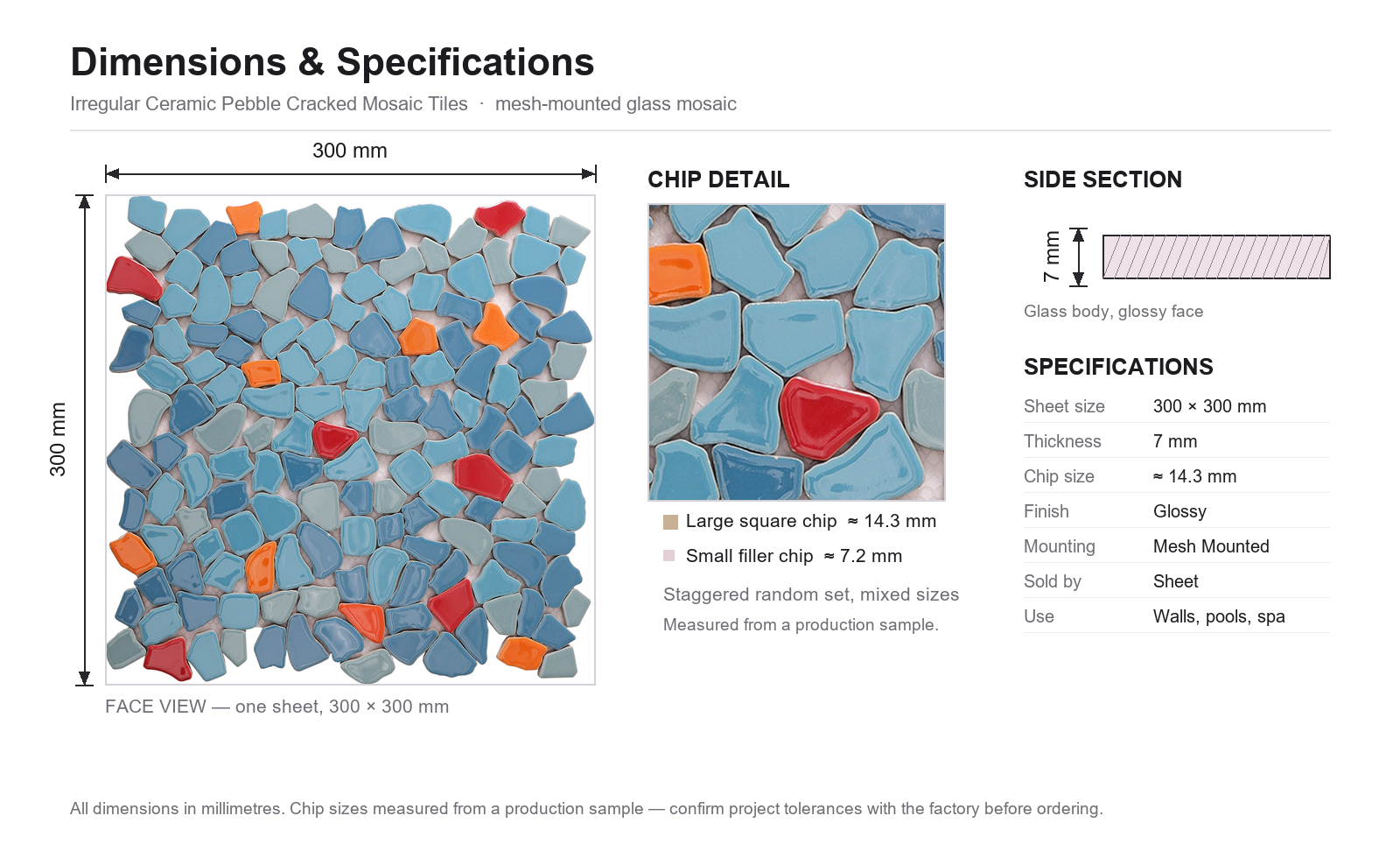
The dimension diagram below puts the numbers on the record. The sheet is 300×300 mm; the average chip measures approximately 14 mm (about 21 chips across the sheet, measured from the actual product); the fired body is 7 mm thick; the finish is glossy; the mounting is mesh-backed.
| Material | Ceramic (glazed) |
| Sheet size | 300 × 300 mm |
| Chip size | ≈ 14 mm average (irregular pebble shape; measured from the sheet) |
| Thickness | 7 mm |
| Finish | Glossy (crackle glaze) |
| Mounting | Mesh mounted |
| Sold by | Sheet (22 sheets per box, ≈1.98 m² per box) |
| Applications | Indoor and outdoor walls, shower walls and floors, steam rooms, swimming pools |
Two practical notes on those numbers. First, coverage: at 0.09 m² per sheet you need roughly 11.1 sheets per square metre, and boxes of 22 sheets cover just under two square metres — convenient for estimating, since a 10 m² feature is about five boxes plus cutting allowance. Second, the 7 mm body is thinner than most field tile, so plan the wall build-up accordingly: mosaics like this sit happily flush inside a niche or against a trim profile, and your tiler will thank you for deciding the transition detail before installation day.
Three Spaces, Three Moods
Numbers describe the sheet; the scenes below describe the room. Each visualisation keeps the mosaic to a single accent surface, which is how professional designers deploy a pattern this characterful.
The Spa Bathroom: A Waterfall of Blue
The first scene is a freestanding-tub bathroom in a boutique property. The mosaic runs as one vertical strip, roughly 300 mm wide, floor to ceiling on the shower wall behind the tub. The model in the robe gives the scale away: the band is narrow, the chips are small, and from six metres the surface reads as a fine granular waterfall rather than a tiled wall. The room’s other materials — light oak, honed limestone, white plaster — stay quiet, so the blue strip carries the entire accent duty. This is the “one confident move” formula, and it works because the red and orange chips give the eye a reason to keep returning to the band. Step into the shower and the scale flips: at arm’s length you can read every crackle line on every chip, which is exactly the kind of detail guests remember and photograph.

The Lobby: Cool Blue Against Warm Timber
The second scene tests the palette against a harder brief. In the hotel lobby below, a slender divider panel beside the concierge desk is clad floor-to-ceiling with the mosaic, about 300 mm wide. Everything around it is warm — oak slat walls, brass lighting, terrazzo — and the cool blue strip cuts through the warmth like a window onto water. The model walking past shows the real effect: the surface changes as you move, chips flashing glossy and matte in alternation. For front-of-house specification, this is the kind of accent that defines a property’s photograph without adding construction complexity — it installs on a standard framed wall with standard thinset, and the mesh backing makes the panel layout forgiving.

The Pool: Built for the Waterline
The third scene is where glazed ceramic mosaics prove their engineering. Along the waterline of the resort pool below, a 250 mm band of the same mosaic rides the water’s edge. Fully vitrified glaze tolerates chlorine, UV and brush cleaning without fading; the small chips conform to the pool’s curves better than any rigid large tile could; and the blue-on-blue relationship between band and water is a designer’s gift — the mosaic reads as a darker, textured echo of the pool itself, with the red accents marking the edge like lane ropes. The swimmer in the frame is there for scale: note how fine the chip texture reads even at this distance.

Working the Palette: Grout, Light and Placement
A pattern with this much movement needs a steady hand around it. Grout should be a pale sand or soft grey, close to the lightest blue chip — high-contrast grout would fragment the pebble field and double the visual noise. Lighting should graze the surface: under-cabinet strips in a shower niche, wall washers in a lobby, or plain daylight on a pool will all make the crackle glaze sparkle, while flat overhead downlighting will flatten it. And placement should follow the one-accent rule: a single band, panel or niche per room. The moment the mosaic competes with a second patterned material — a patterned floor, a printed wallpaper — both lose. Designers pairing this tile successfully almost always choose plain, tactile neighbours: limewash walls, travertine, pale timber, linen. For more placement frameworks, the hotel mosaic design guide breaks down where accent mosaics earn their cost per property zone.
Sourcing at Factory Cost From Foshan
This tile ships factory-direct from Foshan, Guangdong — the ceramic capital that produces the overwhelming majority of the world’s glazed tile. Buying at the source has two compounding advantages. The obvious one is price: without distributor and showroom margins stacked on top, the per-square-metre cost of a glazed pebble mosaic drops to a fraction of retail, which matters when a lobby or a spa spec calls for 20, 50 or 200 square metres. The less obvious one is control. Because the glazing happens in-house, batch consistency is documented, custom chip ratios are negotiable at project volumes, and the same production line can match a follow-up order months later — the nightmare scenario with third-party stock is discovering your two-year-old accent tile was discontinued. Samples ship worldwide so procurement can verify the glaze, the chip mix and the mesh quality before signing anything. If you are building a comparison sheet for a hospitality project, the hotel mosaic procurement guide walks through the questions to ask any supplier — batch control, mesh type, freeze-thaw rating, sample-to-order consistency — and why factory-direct suppliers answer all four easily.
Installation Notes and Everyday Care
Installation is standard mesh-mosaic work, but three details separate a good result from a great one. Set sheets against a levelled, waterproofed substrate and use a white thinset so no grey shows through the translucent mesh at the joints. Maintain the sheet joints at the sheet’s natural width and keep sheet-to-sheet alignment within a millimetre or two — on a small-chip field, misaligned sheets read instantly. Grout unsanded and pale, and in wet areas seal the grout after full cure. Care afterwards is genuinely minimal: pH-neutral cleaner, soft brush, done. Avoid acid descalers anywhere near the mosaic — they attack grout, not glaze. In pools, brush the waterline band weekly in season; on shower walls, a squeegee pass after use keeps the glossy chips spotless between deep cleans. Steam rooms need only one extra habit: cycle the ventilation after each session so the joints dry.
Frequently Asked Questions
What do the red and orange chips actually look like in person?
They are the same glossy crackle-glazed ceramic as the blue chips, fired in cherry red and vivid orange. They make up roughly five to eight percent of each sheet and are scattered irregularly, so no two sheets repeat the same distribution. From across a room the field reads blue; up close the warm chips become small discoveries. If your scheme cannot take warm accents, ask BiliTiles about a blue-only chip mix at project volume — the factory glazes in-house, so ratio changes are realistic requests.
Is this tile suitable for shower floors and pool floors?
The manufacturer rates it for shower walls and shower floors, and for swimming pools. The irregular pebble surface gives more grip than a flat tile underfoot, which is precisely why pebble mosaics are a classic shower-floor choice. For pool basins, confirm local code on slip ratings and use a rated thinset for submersion; the waterline band shown in the visualisation is the most common and safest commercial application.
How do I calculate quantities for my project?
Each 300×300 mm sheet covers 0.09 m². Divide your area by 0.09, then add 10% for cuts and spares. A 12 m² lobby panel, for instance, needs about 147 sheets — roughly six and a half boxes of 22. For complex layouts with niches or curves, take the extra allowance to 15% and send your elevations to BiliTiles for a take-off check before ordering.
Where do I see the current price and order a sample?
Everything is on the product page: Irregular Ceramic Pebble Cracked Mosaic Tiles. The page lists box configuration and factory pricing, and there is a sample request option so you can check the crackle glaze and chip mix under your own project lighting before committing.
The Short Version
If your project needs one surface that people will actually remember — a spa strip that calms, a lobby panel that stops traffic, a pool edge that photographs — the Irregular Ceramic Pebble Cracked Mosaic Tiles deliver it at factory cost, with the engineering to survive water, steam and sun. Compare it with the rest of the glazed bodies in the ceramic and porcelain mosaic tiles collection, order the sample, and hold the real thing up to your lighting. Blue this layered does not come from a printer.