Dark Gray Blue Hexagon Ceramic Crackle Mosaic Tile: A Moody, Textural Surface for Spa and Hospitality Interiors
There is a particular kind of quiet that good hospitality interiors aim for, and it is not emptiness. It is a low, steady hum of material confidence: a surface that looks like it has weight, that holds shadow, that does not need to shout to be noticed. The Dark Gray Blue Hexagon Ceramic Crackle Mosaic Tile is built for that register. Its chips sit somewhere between charcoal and storm-blue, and the crackle glaze fractures the surface into a thousand hairline glints, so the wall never reads as one flat colour. In a spa bathroom it feels like wet slate. In a lobby it reads as tailored stone. At a pool edge it turns the waterline into a deliberate detail rather than a seam you try to hide.
This is a ceramic mosaic, not a large-format tile, and that distinction matters more than most spec sheets admit. A six-hundred-millimetre slab is a sheet of colour. A hexagon mosaic is a field of small decisions: thousands of chip edges, a thin grout lattice, and a rhythm that catches light at every angle. The result is a surface with depth, and depth is what separates a photographed interior from a remembered one.
Dark Gray Blue Hexagon Ceramic Crackle Mosaic Tile
Ceramic · 260 × 300 mm sheet · 8 mm thick · glossy crackle glaze · mesh mounted, sold by the sheet
The Sheet, Up Close
Before any rendering, look at the real sheet. Photographed flat on a white background, the mosaic shows exactly what ships: hexagonal chips laid in a staggered honeycomb, each chip roughly fifty millimetres across, with a narrow and even grout gap running between them. The glaze is where the character lives. Under raking light the crackle network appears as fine, irregular lines, the mark of a glaze that shrank at a slightly different rate than the body beneath it, and the blue-grey tone drifts from chip to chip, some leaning slate, others a colder graphite.

It is worth being precise about what mosaic means here, because the word is often stretched to cover anything small. This is a true mosaic: many individual glazed ceramic hexagons, mesh-mounted so the sheet flexes and follows a wall, with grout treated as an intentional part of the design rather than a seam to be minimised. The chip repeat is uniform, one hexagon module repeated, and the visual variety comes from the crackle glaze and the natural tonal shift of a fired ceramic rather than from mixing dramatically different chip sizes. That uniformity is a feature. It keeps a large wall calm. A staggered honeycomb set, viewed from a few metres back, resolves into a soft granular shimmer instead of a busy pattern.
Dimensions and Specifications
The sheet is 260 by 300 millimetres (10.24 by 11.81 inches) and eight millimetres thick, a dimension chosen so a single sheet is easy to handle on a vertical surface while still covering enough area to keep grout lines out of the way of the pattern. Chip size is not printed on the product page, so the figure below is measured from a production sample and should be treated as an approximation; confirm final tolerances with the factory before you place a large order.

| Material | Ceramic |
| Sheet size | 260 × 300 mm (10.24 × 11.81 in) |
| Chip size | ≈ 50 mm hexagon (measured from sample) |
| Thickness | 8 mm (0.315 in) |
| Finish | Glossy, crackle glaze |
| Mounting | Mesh mounted |
| Sold by | Sheet (≈ 0.84 sq.ft. per sheet) |
| Applications | Interior and exterior walls, shower walls, spa and pool surrounds |
Because each sheet covers only about 0.84 square feet, order by the sheet but calculate by the square metre. Add ten to twelve per cent for cuts, corners and the inevitable chipped hexagon at the edge of a niche.
In a Bathroom: A Vertical Slate Ribbon
The most natural home for this colour is a wet room. In the bathroom below, the mosaic is used as a narrow vertical ribbon beside a shower and as the lining of the niche, not as a full wall. That restraint is deliberate. A dark, glossy surface across an entire room can feel like a cave; confined to a twenty-eight-centimetre strip and a recessed niche, it becomes a line of shadow and sheen that draws the eye exactly where the architecture wants it. The freestanding tub stays pale and quiet while the mosaic does the talking.

From seven metres back the chips read as small, individual facets. You can count the hexagons across the ribbon and see the grout between them, which is the correct scale for a real mosaic. If a render shows six or seven huge squares across the same strip, the material has been drawn as large-format tile and the whole effect collapses.
In a Hotel Lobby: The Counter That Anchors the Room
In commercial interiors the same sheet does a different job: it gives a reception counter a base. Here the mosaic wraps the curved front of a stone desk in a sixty-centimetre band, meeting the floor in a shadow gap and the countertop in a thin brass reveal. Two guests at the desk provide scale. The band is wide enough to read as a material choice and narrow enough to avoid turning the counter into a monolith.

The crackle glaze is unusually good at this distance. At three or four metres the hexagons are still legible; at eight they merge into a textured, almost woven surface. That change of read with distance is something a flat porcelain panel simply cannot do, and it is why designers keep returning to mosaic for reception and bar fronts.
At the Pool: A Waterline With Depth
Ceramic is at home around water, and this blue-grey is at its most convincing as a waterline. Running a fifteen-centimetre band of hexagons between pale limestone coping and turquoise water ties the pool to the building rather than leaving it as a hole in the deck. The gloss picks up caustics, and the dark tone makes the water look deeper and cleaner by contrast.
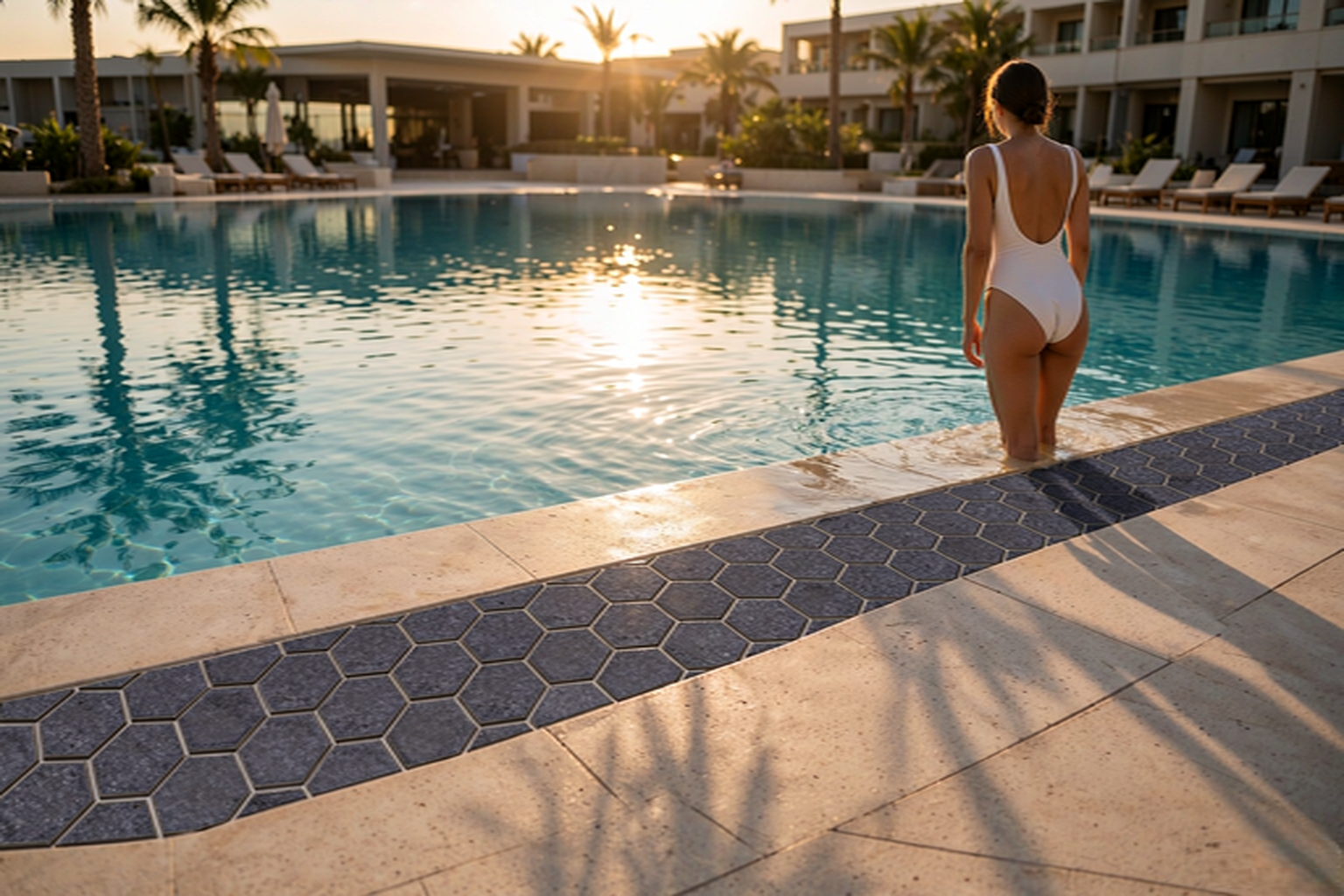
Again, scale is everything. The waterline band should show hundreds of small chips, not a handful of large tiles. When the grain is right the pool edge looks engineered; when it is wrong it looks like a render that has never been in the same room as a trowel.
Designing With Small Chips: Grout, Light, One Focal Surface
Three decisions carry most of the visual weight with a mosaic like this, and all three are cheaper to get right on paper than on site.
Choose grout as a design line, not a gap
A pale, cool grey grout keeps the hexagon geometry crisp and lets each chip read as an object. A grout matched to the darkest chip makes the wall quieter and more monolithic. On a dark glaze, avoid pure white grout unless you want a graphic, almost retro grid; it is a strong look and hard to walk back once it is cured.
Light the surface from the side
Crackle glaze rewards raking light. A downlight directly above flattens it, while a wall washer or a window at an angle reveals the crackle network and the tonal drift. In bathrooms, place the primary light so it grazes the mosaic rather than facing it head-on.
Give it one focal surface
Pick one plane, whether a shower wall, a niche, a counter band or a waterline, and let the rest of the room stay calm. A dark hexagon mosaic used on every surface becomes noise. Used once, it becomes the thing people remember about the room.
Factory-Direct From Foshan: What B2B Buyers Actually Get
Bilitiles works factory-direct from Foshan, the ceramic and mosaic cluster in Guangdong that supplies much of the world’s architectural tile. For a B2B buyer that changes both the economics and the conversation. You are not buying a repackaged container from a distributor; you are specifying a glaze and a format with the people who fire it. That means realistic lead times, the ability to hold a colour across repeat orders, and a sample that actually matches the production run.
It also means you can ask the questions that matter on a project. Can the mesh be cut to a specific module? Can the grout gap be held to a tolerance? Can a batch be reserved for a phased installation? Those are factory questions, and factory-direct is how you get factory answers rather than a shrug and a catalogue.
Specifying for Hospitality and Commercial Projects
For hotels, restaurants and spas, a mosaic is specified as much for maintenance and replacement as for looks. A few practical points carry weight in a specification meeting:
- Repairability. A damaged chip can be cut out and replaced without disturbing the field, a decisive advantage over large-format slabs where one crack can mean replacing a whole panel.
- Flexibility. Mesh-mounted sheets conform to slight curvature and irregular substrates, which matters on older buildings and on curved counters.
- Wet-area performance. Glazed ceramic is dimensionally stable and easy to clean; it suits shower walls, spa surrounds and pool waterlines. Confirm slip requirements separately for any floor use.
- Phasing. Because the colour is held at the factory, a renovation can be completed wing by wing over months without a visible batch break.
If you are assembling a procurement pack, our hotel mosaic procurement guide walks through the documents and tolerance questions that keep a specification from drifting between sample and delivery.
Installation and Care
The installation is conventional for mesh-mounted mosaic, but a few habits protect the result.
- Use a white or light-grey thin-set; a dark adhesive can shadow through pale grout and change the read of the field.
- Flat-trowel the substrate and back-butter the sheet lightly so the mesh is fully embedded without adhesive squeezing into the joints.
- Work in small areas and clean the joints before the thin-set skins over; crackle glaze has fine lines that trap residue if you wait.
- Seal only if the project requires it; a glazed ceramic is already low-absorption, and the wrong sealer can dull the crackle.
- Clean with a pH-neutral cleaner and a soft pad, and avoid acid-based descalers on cementitious grout.
For day-to-day care, warm water and a microfibre cloth handle most of it. The gloss is forgiving; the crackle is the part to protect from abrasive pads.
Frequently Asked Questions
Is this a large-format tile or a true mosaic?
It is a true mosaic. Each hexagon is an individual glazed ceramic chip, mesh-mounted into a 260 by 300 millimetre sheet. The chips are roughly fifty millimetres across, so a wall reads as a field of small facets rather than a single slab.
Can I use it in a shower or around a pool?
Yes. Glazed ceramic suits shower walls, spa surrounds and pool waterlines. For a shower floor or a pool floor, check the slip rating with the factory before specifying, because floor use has different requirements from wall use.
Where can I see the price and request a sample?
Pricing is by the sheet and quoted per project on the product page. You can see the sizes, the factory price and request a physical sample directly on the Dark Gray Blue Hexagon Ceramic Crackle Mosaic Tile product page.
How much should I order?
Each sheet covers about 0.84 square feet. Measure the net area, then add ten to twelve per cent for cuts, corners and niche returns. For a phased hotel installation, ask the factory to reserve a batch so the colour stays consistent across deliveries.
Where to Go Next
If the room you are planning needs a surface that holds shadow, catches light and still reads as a material rather than a graphic, this hexagon crackle mosaic is worth a closer look. Start with the Dark Gray Blue Hexagon Ceramic Crackle Mosaic Tile for sizes, factory pricing and a sample request, then browse the wider ceramic and porcelain mosaic tile range for related formats and glazes. For the design thinking behind projects like this, read our guide to mosaic art in hotel design.