Craquelure — the fine network of cracks in an old glaze — is one of those accidents of ceramic chemistry that designers keep trying to reproduce on purpose. The Cracked Ceramic Mosaic Art Tiles do it honestly: each chip is cut by hand into an irregular shape, then finished with a glossy glaze that breaks across the surface in warm amber, honey and golden ochre. The result is a surface that behaves like a piece of art at one metre and like a texture at five.
Product: Cracked Ceramic Mosaic Art Tiles
300 × 300 mm mesh-mounted sheets · 7 mm thick · glossy crackle glaze · sold by the sheet
View sizes, factory price and request a sample →
This is not a printed imitation. The colour variation you see comes from the glaze itself — thicker in some areas, thinner in others — which is why no two sheets repeat. Below we show the actual sheet, the measured dimensions, and the collection installed in three settings that suit its warmth.
The Sheet, Up Close
Here is the production sheet, photographed flat on white with no rendering and no colour grading.

The actual production sheet: irregular hand-cut chips in amber, honey and ochre, set on a fibreglass mesh backing.
Two details matter for specification. First, the chips are irregular by design — roughly 20 to 40 mm across, no two the same shape, loosely packed with a narrow pale grout line between them. That irregularity is what makes the surface read as hand-laid rather than manufactured. Second, the glaze is a crackle glaze: the fine crazing is fired into the surface, not applied afterwards, so it will not wear off in a wet area.
Because the chip shapes vary, the visual rhythm of the wall comes from the grout pattern as much as from the chip colour. This is the opposite of large-format porcelain, where the joint is deliberately hidden. With this material the joint is part of the design.
Dimensions and Specifications
Everything below is measured from a production sample rather than copied from a catalogue.
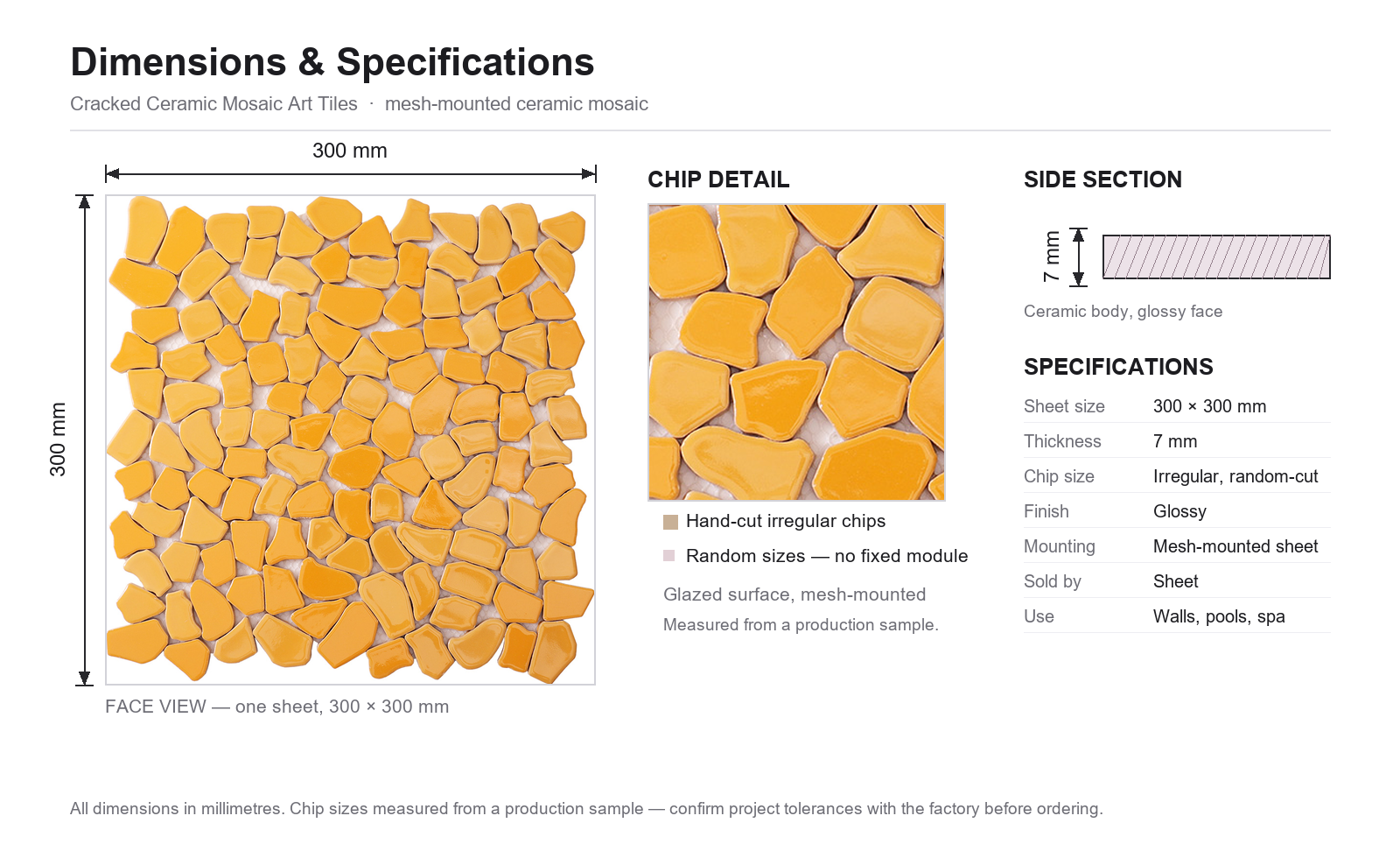
Face view, chip detail and side section — drawn to the production specification.
| Material | Ceramic, crackle-glazed |
| Sheet size | 300 × 300 mm |
| Chip size | 7 mm |
| Thickness | Irregular hand-cut, approx. 20–40 mm |
| Finish | Glossy |
| Mounting | Mesh-mounted sheet |
| Sold by | Sheet — quoted per sheet or per m² |
| Applications | Interior walls, backsplashes, spas, pool waterlines, hotel interiors |
A 300 mm sheet is small on purpose. At this size the sheets are easy to handle on curves, niches and column wraps, and the joints between sheets disappear into the general irregularity of the pattern. For a plain wall, expect roughly eleven sheets per square metre plus a cutting allowance of about ten per cent.
Three Rooms That Suit Warm Crackle Glaze
1. The Bathroom Vanity Wall
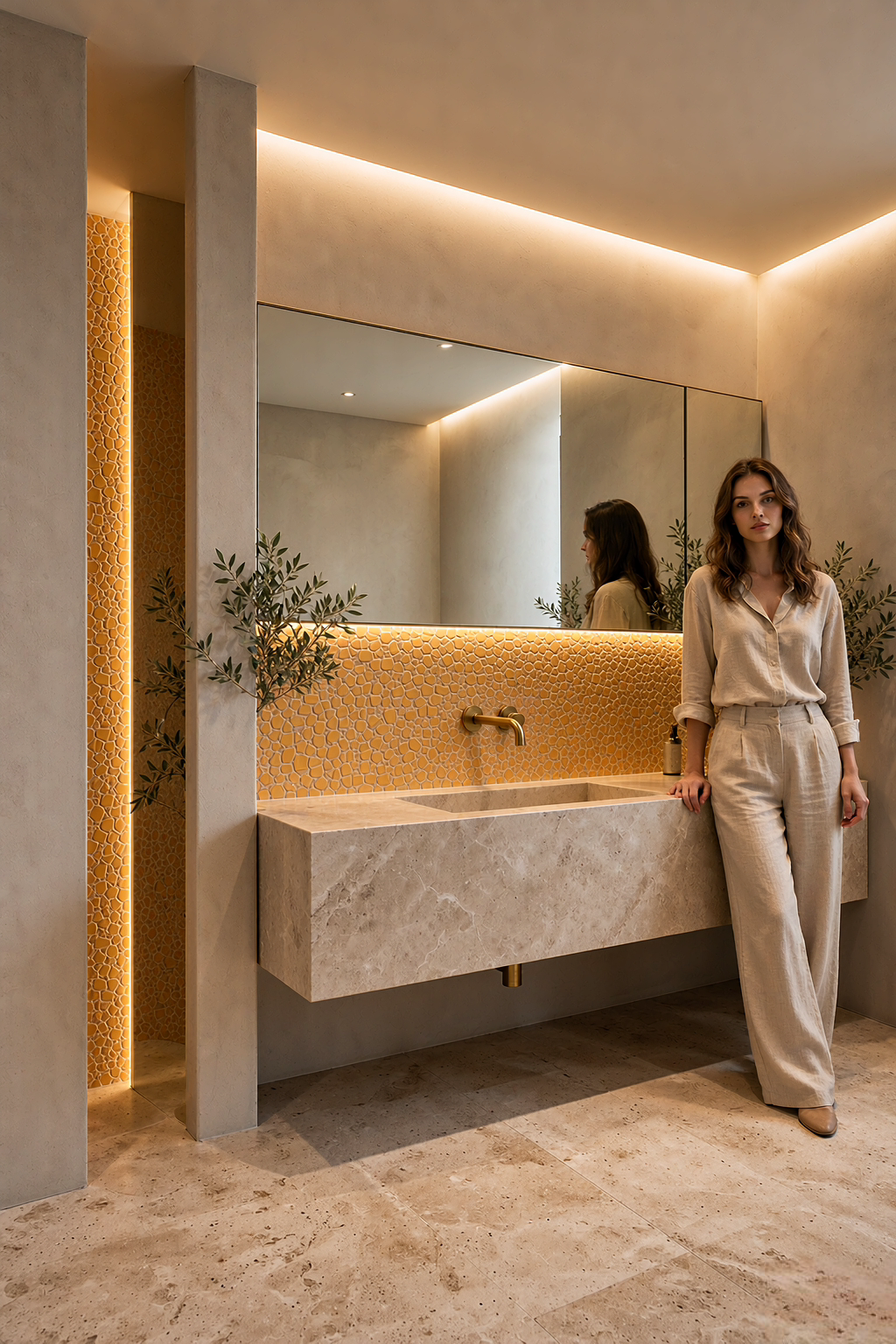
Amber and honey read as warmth rather than colour, which is exactly what a stone-heavy bathroom needs. In this setting the mosaic runs as a panel behind the vanity and a narrow strip inside the shower niche, so the glaze catches the cove light and throws a soft golden reflection back into the room. If you are planning a wellness-led bathroom, our spa-like bathroom design guide covers lighting, layout and material pairing in more detail.
2. The Hotel Lobby
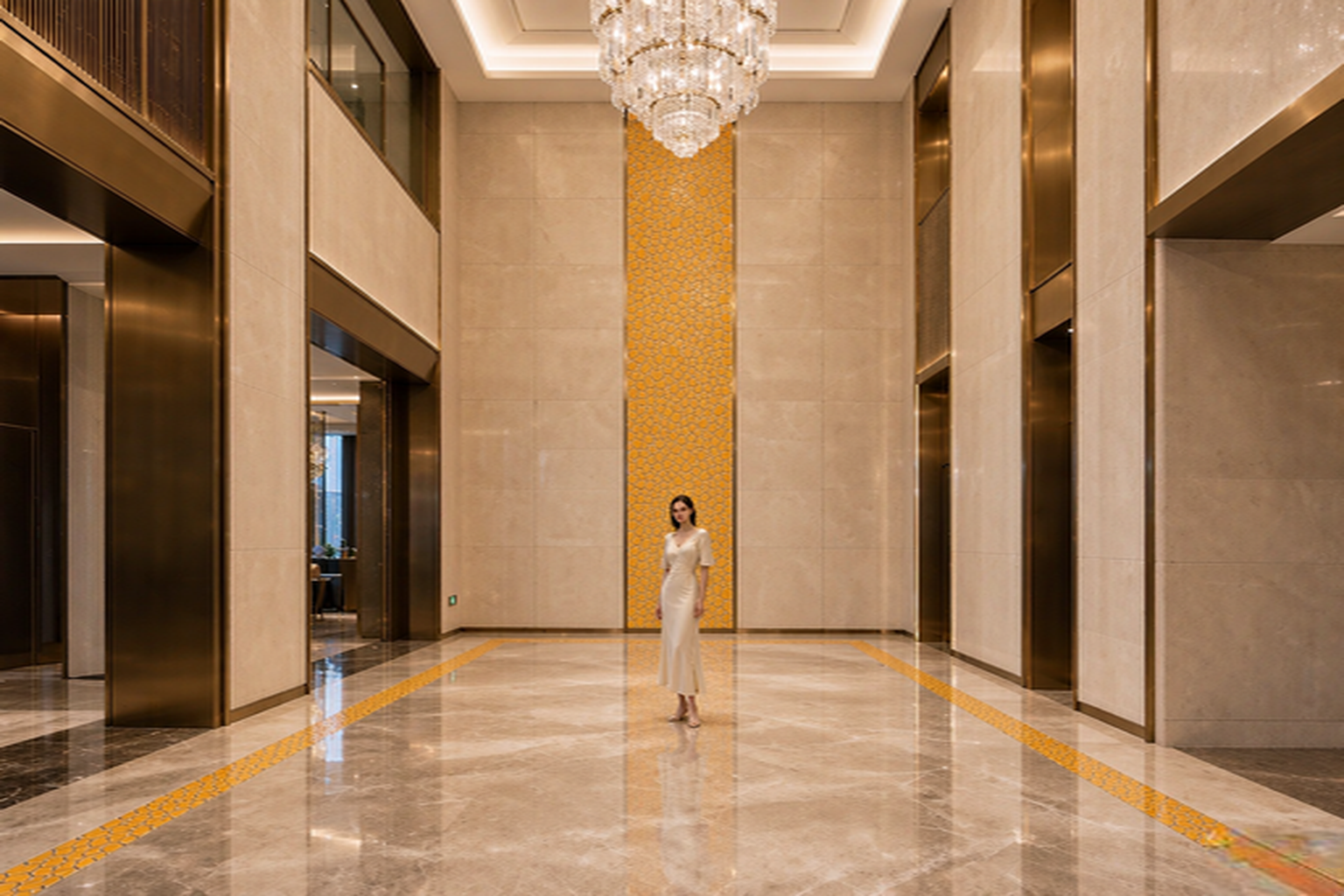
In a large volume, warm amber is the one colour that survives distance. Here it is used as a narrow vertical strip running the full height of the lift lobby wall, with a slim floor border picking up the same tone on the ground plane. From across the lobby the strip reads as a fine thread of gold rather than a decorated panel — the correct behaviour for mosaic at architectural scale. Our hotel mosaic design guide sets out the full specification method.
3. The Spa Pool Waterline
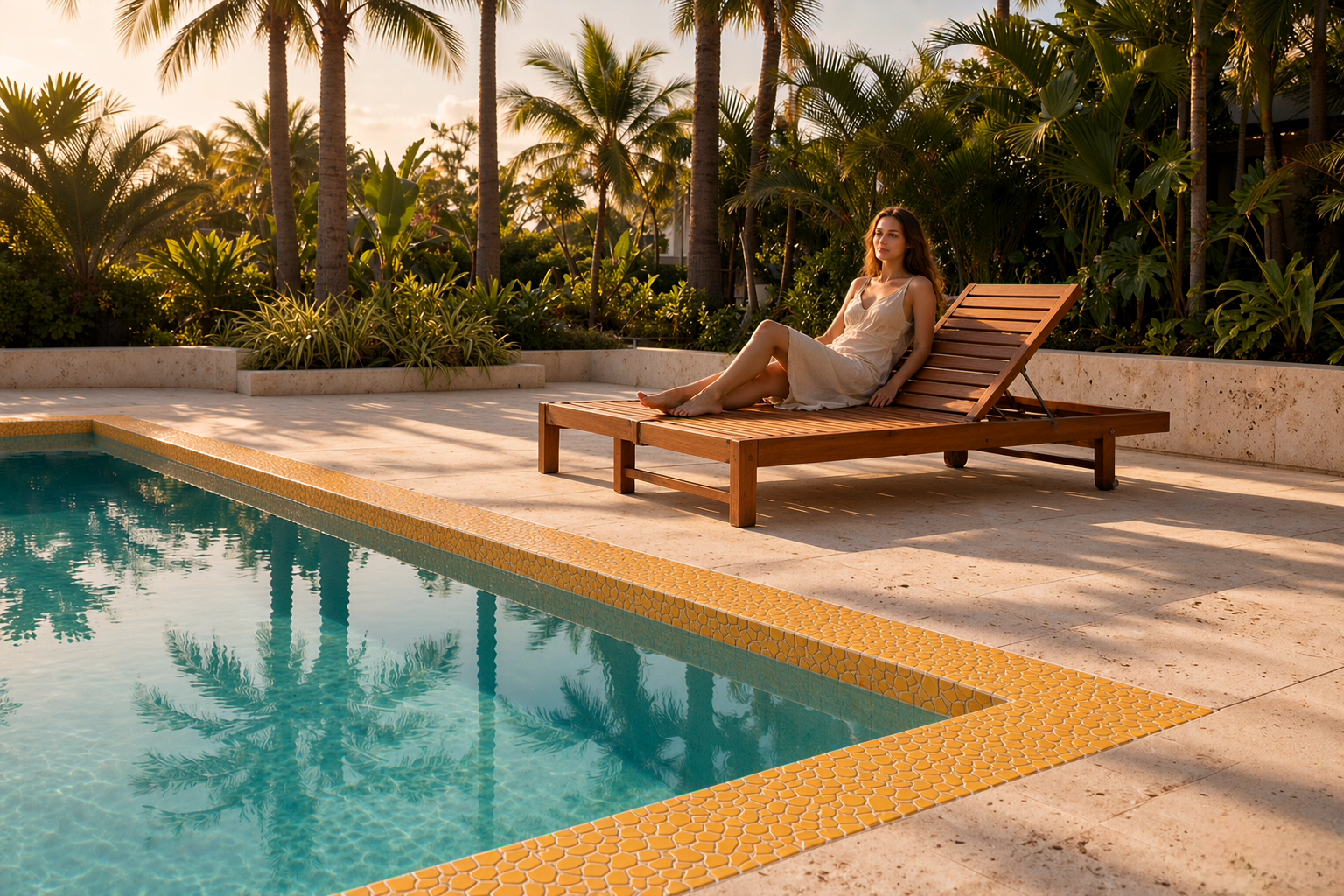
Amber against turquoise is a classic pairing for a reason: the two colours sit almost opposite each other on the wheel, so a thin amber waterline makes the water look deeper and clearer. The glazed surface also wipes clean, which matters on a pool edge that sees sunscreen and chlorine.
Designing With Irregular Chips
- Let the irregularity do the work. One feature wall or one niche is enough. Pair it with quiet, rectilinear neighbours — honed stone, plaster, dark metal — or the room starts to feel busy.
- Choose grout deliberately. A warm mid-tone grout keeps the surface reading as a continuous golden field; a pale grout makes every chip silhouette visible. Both are valid, but they produce very different walls.
- Light it from the side. A crackle glaze lives on reflected highlights. Grazing light from a cove or wall washer makes the crazing visible; flat downlighting hides it.
- Respect the thickness. At 7 mm these chips are thicker than glass mosaic, so plan a slightly deeper adhesive bed and check the transition detail where mosaic meets large-format tile.
Why Factory-Direct Matters With a Crackle Glaze
BiliTiles manufactures in Foshan, the ceramic and mosaic centre of southern China, and sells directly from the factory. For a crackle-glazed product that matters more than usual. Crackle is a function of glaze chemistry and firing curve: small changes in either shift the colour and the crack pattern. Buying from a reseller means buying whatever batch happens to be in a warehouse, and topping up a project six months later from a different batch. Buying from the source means the same glaze recipe and the same firing profile can be reserved for your whole project, and we can produce a matched top-up run if your site needs one.
Customisation is also easier at source: the amber-to-ochre ratio can be adjusted, chips can be mounted in specific patterns, and the same glaze can be used for custom mosaic lettering and signage. See our custom mosaic lettering guide if you need a logo or a nameplate in this finish.
Specifying for Hospitality and Commercial Work
Send drawings, reference images or a mood board and we will produce a physical sample of the exact blend before you commit. For hotel and resort projects we routinely support phased deliveries so lobby, spa and pool areas can be installed on separate schedules without colour drift between phases. Quantities are quoted per sheet or per square metre at factory-direct pricing, and our team can advise on adhesive, grout and substrate preparation for wet, submerged or high-traffic conditions.
Installation and Care
Sheets arrive mesh-mounted, which keeps the irregular joints consistent and makes installation far quicker than loose-lay mosaic. Use a white or neutral thin-set; for submerged areas use a pool-rated adhesive and a full waterproofing system. Seal the grout — not the tile face — in wet zones. Day to day, a pH-neutral cleaner and a soft cloth are all the glaze needs; avoid abrasive pads, which dull grout far sooner than they dull fired glaze.
Frequently Asked Questions
Is the crackle effect a defect?
No. The crazing is fired into the glaze on purpose and is stable. It will not flake, and it does not affect water resistance when the substrate is correctly waterproofed.
Can I use it in a shower?
Yes, with a properly waterproofed substrate and sealed grout. The glaze itself is non-porous.
Can I combine it with other colours?
Yes. As the factory we can blend the amber range with complementary tones or produce a gradient across a wall. Share a reference and we will quote a sample.
Where can I see the price and order a sample?
Both are on the Cracked Ceramic Mosaic Art Tiles product page.
Crackle Glaze Versus a Printed Imitation
There is a cheap way to sell this look: print a photograph of cracked glaze onto a flat tile and call it crackle. The difference shows up in three places. First, depth — a real crackle glaze is transparent, so the crazing sits under a layer of glass and shifts as you move past it; a print is flat and stops changing at about a metre. Second, edges — printed chips are cut square and then decorated, so the pattern has to be trimmed to fit; hand-cut chips take the glaze with them. Third, repetition — a print repeats every few sheets, while a fired crackle never repeats at all. If you are comparing quotes from several suppliers, ask whether the crackle is fired or printed. It is the single question that explains most of the price difference.
Matching This Range With Other Materials
Amber crackle is a warm material, and it is easiest to place next to other warm materials: honed travertine, lime plaster, aged brass, oiled oak, terracotta. The combinations that fail are the cold ones — polished chrome, cool grey porcelain, blue-white LED lighting — because they pull the glaze toward orange and make it look synthetic. A useful test is to put the sample next to the actual tapware and the actual paint colour, not next to another tile. If the sample still looks good against the fittings, it will work on the wall.
Bring Some Warmth Into the Room
Amber crackle glaze is a small material decision with a large effect: it turns a neutral bathroom into a warm one and gives a large lobby a point of focus without shouting. Browse the wider ceramic and porcelain mosaic collection, or go straight to the product page for sizes, pricing and samples.