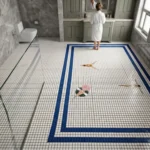
A mosaic tile floor medallion is the single highest-impact way to make an entrance, foyer, lobby, or bathroom floor feel custom without replacing the entire room. Unlike a fully tiled mosaic surface, a medallion is a focal feature — a circular, oval, square, or free-form inlay of small tiles set into a larger field of stone, porcelain, or wood. Done well, it reads as bespoke architecture. Done poorly, it cracks, flakes, or clashes with the surrounding floor.
This guide covers what a floor medallion actually costs to build, which materials survive foot traffic and thermal shock, how it is installed so it stays flat and crack-free, and the design rules that separate a showpiece from a floor sticker.
What a Mosaic Floor Medallion Is (and Is Not)
A medallion is distinct from a mosaic rug or an all-over mosaic floor in three ways:
| Characteristic | Floor Medallion | All-Over Mosaic Floor |
|---|---|---|
| Substrate load | Point load at center of room | Distributed load |
| Thickness profile | Often inset into a recessed bed to stay flush | Laid as a full-height finish layer |
| Design intent | Focal point, wayfinding, brand statement | Texture and color field |
The defining engineering challenge is flushness and differential movement. The medallion is a foreign insert inside a larger assembly. If the surrounding field (say, 12 mm porcelain tile) and the medallion (say, 4–8 mm glass mosaic) are not brought to the same finished height, you get a lip — a trip hazard and a grout-line failure point.
Material Selection: What Actually Survives a Floor
Not every mosaic material belongs underfoot. The floor is the harshest environment in the building: point loading from heels and furniture, abrasion from grit, moisture, and — in foyers near exterior doors — thermal cycling.
Porcelain Mosaic (Recommended for Floors)
Porcelain mosaic is the workhorse of floor medallions. Full-body porcelain carries color through the tile, so chips are invisible. Key specs to require:
- PEI (Porcelain Enamel Institute) rating of 4 or 5 — rated for heavy residential and commercial foot traffic
- DCOF (Dynamic Coefficient of Friction) ≥ 0.42 for wet areas; 0.60+ for entryways that get rain or snow
- Water absorption ≤ 0.5% — vitreous to impervious, essential for frost resistance
- Rectified edges for tight 1/16 in (1.5 mm) grout joints
Porcelain’s weakness is edge chipping during cutting. Budget for a wet saw with a continuous-rim diamond blade, and add 10–15% overage to the order.
Glass Mosaic (Accent Use, Not Field Use)
Glass mosaic delivers the jewel-like color that porcelain cannot. But glass on a floor is a decision, not a default:
- PEI ratings do not apply to glass. Instead, check the manufacturer’s stated suitability for floor use.
- Glass is harder and more brittle than porcelain; it can crack under point impact (a dropped cast-iron pan, stiletto heels).
- Glass has a higher thermal expansion coefficient than porcelain, so it needs a flexible thin-set and a movement-tolerant grout.
Best practice: use glass as the accent ring, border, or highlight within a porcelain medallion, never as the full walking surface of a high-traffic medallion.
Natural Stone Mosaic (Marble, Travertine, Limestone)
Stone medallions are traditional — marble inlays in lobbies date back to Roman villas. They are beautiful and expensive, and they demand more from both installer and owner:
- Marble is softer (Mohs 3–4) than porcelain (Mohs 7–8); it etches on contact with acidic cleaners, wine, and citrus.
- Marble is porous; it must be sealed before grouting and resealed every 1–3 years.
- Travertine’s natural pitting must be filled and honed flat.
Reserve natural stone for lower-traffic interior foyers and honor a strict sealing schedule. For exterior or commercial entry medallions, porcelain is the safer engineering call.
Smalti and Hand-Cut Glass (Luxury Accent)
Traditional smalti — opaque, hand-cut Venetian glass — is the material of high-end mosaic art. It is stunning but should be used sparingly in a floor medallion, typically as a thin decorative line. Smalti’s irregular surface can trap dirt in a floor application and is not rated for heavy abrasion.
Design Rules That Make the Medallion Work
A medallion fails most often because it is proportioned wrong for its room, not because the tiles are bad.
1. Size It to the Room, Not the Ceiling
A common error is sizing the medallion to the chandelier or a rug. Instead, size to the floor area:
- Foyer / entry (100–200 sq ft): 36–48 in (0.9–1.2 m) diameter medallion
- Large lobby / ballroom (500+ sq ft): 60–96 in (1.5–2.4 m) diameter, or a medallion-and-border composition
- Bathroom floor (50–80 sq ft): 24–36 in (0.6–0.9 m), or a smaller corner medallion
A rule of thumb: the medallion diameter should be no more than one-third to one-half the narrowest room dimension, so it sits inside the field with breathing room.
2. Anchor It With a Border
A medallion reads as intentional when it has a defined perimeter. The classic composition is three concentric zones:
- Outer border ring — a single or double row of contrasting tile, 1–3 in wide
- Field band — a neutral bridge tone that connects the medallion palette to the room floor
- Center motif — the geometric or pictorial focal point
This 3-zone structure is why medallions look “custom” rather than “placed.”
3. Follow the Rule of Contrast, Not Just Match
The medallion must relate to the surrounding floor but not disappear into it. Hold one color constant (usually the field band) to tie the medallion to the room, then push contrast in the center motif. A 60% neutral / 30% mid-tone / 10% accent split keeps the composition grounded.
4. Keep Grout Lines Thin and Uniform
For floors, grout joints of 1/16–1/8 in (1.5–3 mm) are standard. Wide joints in a medallion collect dirt and visually break the pattern. Specify epoxy grout for stain resistance and structural strength, especially for stone and glass combinations.
Installation: The Flush, Crack-Free Method
Floor medallion installation is closer to stone inlay work than to wall tiling. The process below is the method professional installers use to keep the medallion flush and movement-tolerant.
Step 1: Build a Recessed Bed (Not a Surface Mount)
The medallion should sit in a recess in the setting bed so the finished surface is flush with the surrounding field. The recess depth equals the medallion tile thickness plus the thin-set and backer height. This is the step that prevents the “lip” trip hazard.
Step 2: Use an Anti-Fracture or Uncoupling Membrane
Because the medallion is a rigid insert in a larger assembly, uncoupling membranes (e.g., a polyethylene dimple membrane) or anti-fracture membranes isolate it from subfloor movement. This is mandatory over concrete slabs and over any substrate with movement joints.
Step 3: Choose the Right Thin-Set
- Porcelain and glass: polymer-modified thin-set meeting ANSI A118.4 (modified dry-set) or A118.15 (improved modified)
- Glass specifically: a thin-set rated for glass to prevent visible trowel lines through transparent tile
- Large-format stone: ANSI A118.15 with a medium-bed rating to prevent sag
Step 4: Respect Movement Joints
Never bridge a structural movement joint with the medallion. If the medallion spans a joint, the joint must carry through the medallion as a soft joint filled with flexible sealant, colored to match the grout.
Step 5: Grout and Seal in Order
- Grout with epoxy or high-performance grout meeting the tile’s requirements
- For stone, seal before grouting to prevent grout staining, then seal again after cure
- Allow the full cure time before foot traffic — 24 hours minimum for thin-set, up to 72 hours for epoxy grout
What a Floor Medallion Costs (Real Ranges)
Costs vary wildly by material, size, and whether the pattern is stock or fully custom. The table below reflects 2026 U.S. installed pricing.
| Component | Stock Porcelain Medallion | Custom Stone Medallion |
|---|---|---|
| Design / templating | Included (catalog) | $500–$2,500+ |
| Installation labor | $15–35 / sq ft | $25–60 / sq ft |
| Membrane + prep | $3–8 / sq ft | $5–12 / sq ft |
| Sealing (stone) | N/A | $2–5 / sq ft |
A 48 in (4 ft) diameter medallion is roughly 12.6 sq ft. A stock porcelain medallion of that size lands around $380–$920 installed, while a fully custom marble medallion can reach $2,500–$6,000+ once design, templating, and stone selection are included.
For BiliTiles custom mosaic medallions, the value comes from the design and templating — every medallion is rendered as a digital proof before a single tile is cut, so you see the exact pattern, color, and border composition before committing.
7 Common Mistakes That Ruin a Medallion
- Sizing to a rug instead of the room — leaves the medallion floating awkwardly in the field
- Using wall-rated glass on a floor — point-impact cracks
- Skipping the recess — creates a trip-hazard lip
- No uncoupling membrane over concrete — hairline cracks telegraph through
- Bridging a movement joint — guaranteed crack line
- Grouting stone without sealing first — permanent grout staining
- Buying zero overage — a single broken tile stalls the whole install
FAQ
Can a mosaic floor medallion go over existing tile?
Only if the existing floor is sound, clean, and you build up a flush recess. In most cases the surrounding field is retiled or the existing tile is ground flush. Over-laying without addressing height creates a lip.
How long does a porcelain medallion last?
With proper installation over a membrane, a porcelain medallion lasts the life of the floor — 30+ years. Stone medallions last equally long structurally but require resealing every 1–3 years.
Is a medallion worth it in a bathroom?
Yes, as a smaller focal feature (24–36 in). It elevates a builder-grade bathroom floor into a custom look at a fraction of the cost of a full mosaic floor.
Do I need a designer?
For a stock pattern, no. For a custom medallion that must match an existing floor and brand palette, a rendered proof — like the one BiliTiles provides — is strongly recommended.
The Bottom Line
A mosaic tile floor medallion is the most efficient way to add a custom, architectural focal point to a floor without a full-room mosaic commitment. The keys are material discipline (porcelain for the field, glass and stone as disciplined accents), correct proportioning, a flush recessed installation over an uncoupling membrane, and a rendered design proof before cutting begins. Get those right, and a 4-foot circle of tile will do the visual work of a six-figure custom floor.
BiliTiles produces custom mosaic tile floor medallions — from porcelain geometric patterns to hand-cut stone and smalti centerpieces — with a full digital proof before production. Contact us to template your foyer, lobby, or bathroom floor.