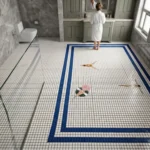
A mosaic tile accent wall is the single highest-impact surface you can add to a room. Where paint and wallpaper sit flat against the eye, mosaic glass catches light at a hundred angles, and every inch of it is handmade, permanent, and impossible to ignore. This guide walks through the materials, design decisions, installation requirements, and real costs of a mosaic accent wall, so you can specify one with confidence instead of guesswork.
What Is a Mosaic Accent Wall?
A mosaic accent wall is a feature wall clad in small tiles — usually 2.5 cm (1 in) or smaller, mounted on mesh-backed sheets — installed on one vertical surface to create a focal point. The rest of the room stays neutral, which is exactly what makes the accent wall work: contrast, not coverage.
Mosaic accent walls differ from standard tile walls in three practical ways:
- Sheet format. Mosaic tiles arrive as 30 × 30 cm (12 × 12 in) mesh-backed sheets rather than individual pieces, which keeps installation fast and alignment predictable.
- Grout is structural. With hundreds of joints per square metre, grout does more work visually and mechanically than it does on large-format tile.
- Weight and substrate matter. Glass and stone mosaics are heavier than paint by an order of magnitude, so the backing wall has to be flat, clean, and properly prepared.
Material Options for Mosaic Accent Walls
The material you choose changes the price, the look, and where the wall can live. Here is how the four main options compare.
| Material | Typical cost per sq m | Best rooms | Key trait |
|---|---|---|---|
| Porcelain mosaic | $30–$120 | Bathroom, entry, fireplace | Durable, matte options, low maintenance |
| Natural stone mosaic | $60–$250 | Living room, feature wall, lobby | One-of-a-kind veining, premium feel |
| Metal / mother-of-pearl | $120–$400+ | Accent strip, luxury detail | Eye-catching, needs sealed grout |
Glass Mosaic
Glass mosaic is the default choice for wet areas and the one most people picture for an accent wall. Because glass is non-porous, it never stains, never absorbs water, and holds its colour permanently — there is no glaze to wear through. The trade-off is that glass tiles need a white thin-set mortar so the adhesive colour does not show through translucent pieces. For a deeper look at glass selection, see our glass mosaic buying guide.
Porcelain Mosaic
Porcelain delivers the look of stone or fabric at a lower cost and with near-zero upkeep. Modern digital-printing techniques reproduce marble veining, linen texture, and even wood grain on porcelain. It is frost-proof and suitable for high-traffic walls. If you want a matte, calm accent wall that will not compete with the room, porcelain is the safest specification.
Natural Stone Mosaic
Marble, travertine, limestone, and slate mosaics bring real depth that no printed tile can match, because every sheet is unique. Stone needs sealing before grouting and periodic resealing after, and it reacts to acids, so it belongs on walls away from vinegar and harsh cleaners. For a full material breakdown, read our natural stone mosaic guide.
Metal and Mother-of-Pearl
These are accent materials, not full-wall materials. A band of brushed brass, stainless steel, or iridescent mother-of-pearl set into a glass field elevates a plain wall instantly. They cost the most per sheet, so the standard approach is to use them as a stripe, frame, or inset rather than covering the entire surface.
Design Ideas That Actually Work
1. The Shower Feature Wall
Run a glass mosaic from floor to ceiling on the back wall of a shower, and keep the side walls in large-format plain tile. The mosaic becomes a waterfall of colour behind the water, and the contrast makes the shower feel larger, not busier. For a full wet-room treatment, see our mosaic bathroom design guide.
2. The Kitchen Backsplash Statement
A mosaic accent wall behind the range or the sink is the classic application. Glass is the practical pick here because it wipes clean of oil and sauce. Choose a field tile with a thin metallic or mother-of-pearl stripe at eye level for a custom look without a custom price.
3. The Bedroom Headboard Wall
A mosaic panel the width of the bed and roughly 1.2–1.5 m tall, set behind the headboard, reads as a piece of art. Natural stone works best here because the room is dry and the stone’s irregular veining suits a calm, residential space.
4. The Fireplace Surround
Mosaic around a fireplace turns a functional box into the centre of the room. Porcelain and stone are the right materials — they tolerate heat better than glass — and a framed border in a contrasting colour sharpens the edge. See our fireplace surround guide for the full approach.
5. The Entryway Feature Wall
A full-height mosaic on the wall facing the front door makes the strongest possible first impression in a home or a boutique hotel lobby. Because this wall takes almost no abuse, you can afford a more delicate material here. Hotels use the same approach for lobby feature walls — see our handmade mosaic art for hotel lobbies.
6. The Commercial Brand Wall
Hotels, restaurants, spas, and offices use mosaic accent walls as brand statements — a logo, a wave pattern, or a signature colour built directly into the wall. This is where custom mosaic work earns its cost, because the wall itself becomes marketing. For hospitality specifications, see our hotel procurement guide.
Where to Use (and Where to Skip) a Mosaic Accent Wall
Best placements:
- Shower back wall and bathroom vanity wall
- Kitchen range and sink backsplash
- Fireplace surround
- Entry foyer and lobby feature wall
- Bar and restaurant front-of-house wall
Places to think twice:
- Exterior walls in freezing climates (unless the tile is frost-rated and the install includes proper movement joints)
- Curved or uneven walls without first flattening the substrate
- Entire rooms — an accent wall works because it is the exception; mosaic everywhere stops being an accent
How Much Does a Mosaic Accent Wall Cost?
Cost breaks into three parts: material, labour, and prep. For a typical 5 m² (about 54 sq ft) accent wall:
| Cost component | Range |
|---|---|
| Professional installation | $400–$1,200 |
| Substrate prep and waterproofing | $100–$400 |
| Typical total | $700–$2,300 |
Mosaic labour is higher than large-format tile labour because installers place and align sheets joint by joint, and the pattern has to stay straight across the whole wall. Budget roughly $80–$150 per square metre for installation in most markets.
Installation Requirements for a Mosaic Accent Wall
Substrate Preparation
The wall must be flat within 3 mm over a 2 m straightedge, clean, dry, and free of loose paint. On drywall, tape and float the seams; on cement board or concrete, fill low spots before tiling. Skipping prep is the number-one cause of wavy, uneven mosaic walls, because mosaic cannot bridge dips the way large tile can.
Thin-Set and Trowel
Use a white polymer-modified thin-set for glass and a suitable thin-set for stone or porcelain. Spread with a 4.5 mm V-notch trowel so adhesive does not squeeze up through the joints, then flatten the ridges before pressing the sheet in.
Grout
Grout is a design decision on mosaic, not an afterthought. A contrasting grout makes the grid pattern the point; a matching grout makes the wall read as one continuous surface. Use unsanded grout for joints under 3 mm, and a flexible or epoxy grout in wet areas.
Sealing
Natural stone and porous porcelain need sealing before grouting and again after. Glass needs no sealer. Mother-of-pearl and metal should be sealed or protected from grout haze with a release treatment.
For a complete step-by-step process, refer to our mosaic installation tutorial.
Maintenance
Glass and porcelain accent walls need almost nothing: wipe with a neutral cleaner and rinse. Stone walls need a pH-neutral stone cleaner and periodic resealing. Avoid abrasive pads on glass and metal, which scratch the surface permanently. The one maintenance task people forget is grout — reseal grout in wet areas every year or two to keep water and soap scum out of the joints.
Why Choose BiliTiles
BiliTiles manufactures custom mosaic accent walls from glass, natural stone, porcelain, and mother-of-pearl, cut and assembled to your exact pattern. We produce full custom designs — logos, gradients, wave patterns, and branded feature walls — as well as ready-made collections, and we ship worldwide with installation documentation included. If you can describe the wall, we can build it.
Frequently Asked Questions
How big should a mosaic accent wall be?
Cover one full surface — the whole back wall of a shower or the full backsplash run — rather than a floating rectangle. A full wall reads as intentional; a small patch reads as unfinished.
Can I install mosaic over existing tile?
Yes, if the existing tile is sound, clean, and deglossed, and the combined thickness works with your trim and fixtures. Otherwise, strip to the substrate for a flatter, longer-lasting result.
Do glass mosaic accent walls scratch?
Glass is scratch-resistant in normal use but can be scratched by abrasive cleaners and pads. Use a soft cloth and neutral cleaner.
Is a mosaic accent wall worth the cost?
For resale and design impact, yes — it is the lowest-cost way to make a room look custom-built, and it is permanent, unlike wallpaper or paint.