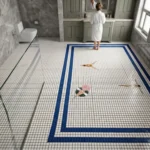
Slip and fall is the single most common accident around a residential or commercial swimming pool. According to industry safety data, the majority of poolside injuries happen not in the water but at the water’s edge — on wet steps, ledges, and the shallow-end floor where bathers step in and out. This is why anti-slip pool mosaic tiles are not an aesthetic afterthought: they are a functional requirement that can mean the difference between a safe pool and a liability claim.
In this guide we cover the slip-resistance standards that actually matter, the materials and surface treatments that deliver grip, and how to specify and install anti-slip mosaic for steps, coping, waterline, and the pool floor.
Why Slip Resistance Matters More Than You Think
Water, body oils, sunscreen, and pool chemicals combine to create an extremely low-friction surface. A tile that feels perfectly safe when dry can become treacherous when wet. Two factors determine real-world grip:
- Surface micro-texture — the microscopic roughness that channels water away from the foot.
- Macro-texture — larger relief, such as raised dots, ribs, or grooves, that provides mechanical interlock even under a film of water.
Glossy glass and polished stone look beautiful but perform poorly in wet zones. Anti-slip mosaic tiles solve this by engineering one or both of these textures into a tile that is still small enough to curve around steps and radii.
Understanding Slip-Resistance Ratings
When you specify pool tile, you will encounter several rating systems. Knowing them prevents you from buying a “non-slip” tile that fails on-site.
DIN 51097 — The Pool-Specific Standard
This German standard is the most relevant for wet, barefoot areas. It classifies surfaces into three classes measured on an inclined ramp with a barefoot operator:
- Class A — inclined plane angle ≥ 12°. Suitable for dry barefoot areas and shallow sloped access.
- Class B — angle ≥ 18°. The minimum recommended for pool surrounds, showers, and changing areas.
- Class C — angle ≥ 24°. Required for areas with continuous water flow, such as pool steps, swim-in edges, and fully submerged walkways.
For any pool step or submerged ledge, specify DIN 51097 Class B or C. Class C is the safer default for steps that are constantly wet.
DIN 51130 / R-Values — Shoe-Based Testing
The R-rating (R9 to R13) tests slip resistance with a shod operator on a wet, oil-contaminated surface. It is less relevant to barefoot pool interiors but useful for the surrounding deck and poolside walkways. For pool decks, target R11 to R13.
PTV (Pendulum Test Value)
Used in the UK and Australia, the pendulum test yields a PTV from 0 to 100+. A PTV of 36+ is considered low slip risk in wet barefoot areas; 45+ is recommended for pool surrounds.
Practical rule: for the pool interior and steps, ask the supplier for the DIN 51097 classification; for the deck, ask for the R-value or PTV.
Materials: Which Anti-Slip Mosaics Perform Best
Glass Mosaic (Frosted / Anti-Slip Finish)
Glass mosaic is a favourite for pool interiors because it is non-porous, chemical-resistant, and available in vivid colours. Standard glossy glass is slippery when wet, but frosted, etched, or textured glass mosaic provides DIN Class B grip while keeping the luminous look. Frosted glass diffuses light and hides water spots better than gloss, a bonus for maintenance.
Ceramic and Porcelain Mosaic
Porcelain mosaic with a matt, structured, or grip-finished glaze is the workhorse of anti-slip pool design. It offers consistent slip ratings (Class B/C), high durability, and a lower cost than glass. For step treads and edges, look for tiles with a raised dot or rib profile that adds mechanical grip.
Natural Stone Mosaic (Honed / Tumbled / Bush-Hammered)
Natural stone brings organic texture but must be specified carefully. Polished marble is dangerous in wet zones. Choose honed, tumbled, or bush-hammered finishes instead:
- Honed — smooth but matt, moderate grip, good for walls and waterline.
- Tumbled — softly worn edges and surface, better grip, suited to steps and rustic designs.
- Bush-hammered / flamed — heavily textured, excellent grip, ideal for pool floors and coping but harder to clean.
Pebble and River-Stone Mosaic
Pebble mosaics are naturally anti-slip because of their domed, irregular surface. They are popular for shower floors and shallow pool edges. The trade-off is comfort: bare feet feel the texture, and grout lines collect more dirt.
Surface Treatments That Add Grip
If you love the look of a specific tile but it lacks grip, surface engineering can help:
- Acid etching — permanently micro-roughens the surface of natural stone and some glass. Uniform and factory-controlled.
- Sandblasting / frosting — creates a fine matt texture on glass and stone.
- Frit or grip additives — anti-slip particles fused into the glaze during firing for porcelain.
- Relief moulding — raised studs, lines, or patterns pressed into the tile body.
Prefer factory-applied treatments over on-site coatings. On-site anti-slip coatings wear off with pool chemicals and traffic, whereas factory treatments are baked into the tile for life.
Where Anti-Slip Matters Most: Zoning a Pool
Not every surface in a pool needs the same grip. Zone the pool and specify accordingly:
| Zone | Risk | Recommended Slip Class | Finish |
|---|---|---|---|
| Pool steps / ladders | High | DIN C, R12+ | Textured ceramic, frost glass, bush-hammered stone |
| Shallow-end floor | High | DIN C | Matt porcelain, pebble |
| Swim-out benches / ledges | High | DIN C | Textured / pebble |
| Waterline band | Medium | DIN B | Honed stone, frost glass |
| Walls (vertical) | Low | DIN A/B | Any finish |
| Coping / deck edge | High (wet) | DIN B/C, R11-R13 | Bush-hammered, flamed, textured porcelain |
Marking steps with a contrasting anti-slip mosaic band on the nosing is a double win: it improves visibility (reducing missteps) and adds grip exactly where feet land.
Installation Notes for Anti-Slip Mosaic
Grip is only as good as the installation. Key points:
- Substrate prep — the surface must be flat, clean, and structurally sound. Uneven substrate causes lippage that becomes a trip hazard.
- Adhesive — use a flexible, water-rated adhesive (C2TE S1/S2 per EN 12004) suitable for pools. Do not skimp on coverage; voids under tile can crack and catch toes.
- Grout depth — keep grout lines flush or very slightly recessed. Deep recesses collect water, algae, and dirt, reducing effective grip.
- Fall and drainage — floor tiles need proper slope (typically 1–2%) so water does not pond. A non-slip tile still slips if standing water is deep.
- Expansion joints — respect movement joints at the waterline and around fittings to prevent cracking.
Maintenance: Preserving Grip Over Time
Anti-slip texture can be defeated by neglect. Soap scum, calcium scale, and algae fill the micro-texture and restore slipperiness.
- Clean regularly with a pH-neutral cleaner; avoid acid on textured stone.
- Remove scale with a diluted solution designed for the specific tile material.
- Avoid waxes, sealers, or polishes on grip surfaces — they create a smooth film that defeats the texture.
- Re-check slip rating annually in high-traffic commercial pools.
Real-World Specification Example
A 2026 hotel spa pool we designed used three anti-slip finishes in one project:
- Steps and swim-out benches: frost-finish glass mosaic, DIN 51097 Class C, in a deep teal with a contrasting pale band on each step nosing.
- Pool floor: tumbled travertine mosaic in a honed, Class C finish for warmth underfoot.
- Coping and deck: bush-hammered granite mosaic, R12, in a tone that ties the interior to the surrounding terrace.
The result met the client’s insurance requirements for slip resistance while keeping the luminous, high-end look glass mosaic is known for.
Frequently Asked Questions
Are all glass mosaic tiles slippery?
No. Standard glossy glass is slippery when wet, but frosted, etched, and textured glass mosaic deliver DIN 51097 Class B/C grip while keeping the luminous, reflective look glass is prized for. Always request the specific slip rating rather than assuming glass means slippery.
What slip rating do pool steps need?
Pool steps are continuously wet and are the highest-risk zone. Specify DIN 51097 Class C (≥ 24° ramp angle) for steps and submerged ledges, or R12–R13 for shod testing on the deck. A contrasting anti-slip nosing band further reduces missteps.
Does anti-slip texture make cleaning harder?
Marginally. Deep textures such as bush-hammered stone and pebble mosaic trap more dirt and scale than smooth finishes, so they need slightly more frequent cleaning. Factory-applied micro-textures (frosting, etching, grip-frit glaze) add grip without significantly increasing maintenance.
Can I add anti-slip treatment to existing pool tile?
You can apply on-site anti-slip coatings, but they are a short-term fix: pool chemicals and foot traffic wear them down, and they must be reapplied. Factory-applied treatments are baked into the tile and last the life of the tile. For permanent results, replace the high-risk zones with factory anti-slip mosaic.
Is natural stone safe for pool floors?
Yes, if specified correctly. Avoid polished marble in wet zones. Choose honed, tumbled, or bush-hammered finishes, and confirm the supplier’s DIN 51097 classification. Tumbled and bush-hammered stone offer excellent grip with an organic, high-end appearance.
Conclusion
Anti-slip pool mosaic tiles are where safety engineering and design meet. By understanding slip-resistance standards (DIN 51097 Class B/C, R11-R13, PTV 36+), choosing the right material and finish for each zone, and installing and maintaining it correctly, you get a pool that is safe, durable, and beautiful. When in doubt, specify one class higher than the minimum — the cost difference is small, and the safety margin is worth it.
For more on specifying the right pool tile, see our swimming pool mosaic specification guide, our luxury pool mosaic design guide, and our glass mosaic buying guide.