Mosaic Art for Luxury Bathrooms: The Complete Guide to Bespoke Tile Design
Introduction
The luxury bathroom has evolved from a purely functional space—transforming into a spa-like retreat into a personal sanctuary—a showcase of design ambition where every surface tells a story. Among the materials available to architects and interior designers, mosaic art occupies a unique position: it combines the permanence of architectural finish with the expressive range of fine art. A custom mosaic bathroom elevates a residence from “premium specification” to “signature space.”
At BiliTiles, we have supplied mosaic art for luxury bathrooms across five continents—from five-star hotel presidential suites to private residences in Bel Air to large-scale commercial installations across hospitality and retail, Knightsbridge, and Sentosa Cove. This guide distills that experience into actionable guidance for designers, architects, and procurement professionals.
In this article, you will learn:
- The material options that define luxury bathroom mosaic design
- Design strategies for showers, floors, accent walls, and vanity backsplashes
- Installation requirements specific to wet environments
- Cost frameworks for budgeting custom mosaic projects
- Real-world case studies from completed luxury projects
—
Why Mosaic Art Defines the Luxury Bathroom
Durability Meets Art
Porcelain and ceramic tile serve their purpose, but mosaic art operates at a different tier. Each tessera—whether glass, natural stone, or precious metal—is individually placed to form a larger visual composition. The result is a surface that withstands decades of humidity, cleaning chemicals, and thermal cycling without fading, warping, or delaminating.
A well-installed glass mosaic bathroom feature wall can maintain its visual impact for 50+ years. Natural stone mosaics—marble, travertine, onyx—age with a patina that enhances rather than degrades their character.
The “Instagram Bathroom” Effect
Luxury hospitality has taught residential design a powerful lesson: the bathroom photograph sells the room. Boutique hotels report that bathrooms featuring custom mosaic art generate 3–5× more social media engagement than equivalent rooms with standard tile finishes. For private residences, the bespoke bathroom has become a statement of taste that translates directly into property valuation premiums.
Design Flexibility Without Compromise
Unlike printed or painted surfaces, mosaic art offers true three-dimensional depth. The play of light across angled glass tesserae changes throughout the day. Water amplifies this effect—a mosaic shower floor shimmers as water flows across it, transforming a utilitarian surface into an experiential one.
—
Material Selection for Luxury Bathroom Mosaics
Choosing the right material for a luxury bathroom mosaic requires balancing aesthetics, performance, and budget. Below is a comprehensive comparison of the five materials most commonly specified for high-end bathroom mosaic projects.
1. Glass Mosaic — The Industry Standard
Why choose glass: Glass mosaic tiles are non-porous, stain-resistant, and available in an extraordinary color range. Modern manufacturing techniques produce glass tesserae with metallic finishes, iridescent coatings, and translucent effects that interact with bathroom lighting in ways no other material can replicate.
Performance characteristics:
- Water absorption: <0.5% (impervious)
- Stain resistance: Excellent (non-porous surface)
- Colorfastness: UV-stable, no fading
- Slip resistance: Can be textured for wet-floor applications (DCOF ≥0.42 achievable)
- Service life: 50+ years with proper installation
Best applications: Shower accent walls, full-height bathroom feature walls, vanity backsplashes, ceiling details above freestanding tubs
Limitations: Glass can show water spots in hard-water areas; consider a whole-house water softener or specify a matte/etched finish for shower floors.
2. Natural Stone — Timeless Luxury
Why choose natural stone: Marble, onyx, travertine, and limestone bring geological authenticity that manufactured materials cannot replicate. Each piece is unique—veining patterns, color variations, and subtle inclusions create surfaces that feel organic and unrepeatable.
Performance characteristics:
- Water absorption: 0.2–0.7% (marble), 1–3% (travertine/limestone, requires sealing)
- Stain resistance: Moderate (requires periodic sealing, typically annually)
- Slip resistance: Naturally textured honed/tumbled finishes achieve DCOF ≥0.42
- Service life: 100+ years (marble), 75+ (softer stones)
Best applications: Classic and transitional-style bathrooms, floor mosaics with medallion patterns, tub surrounds, steam room interiors
Limitations: Requires annual sealing; acidic cleaners (vinegar, citrus) will etch marble and limestone. Specify epoxy grout to minimize long-term maintenance.
3. Porcelain Mosaic — Performance Value
Why choose porcelain: Modern digital printing technology allows porcelain mosaics to convincingly replicate natural stone, wood, and even fabric textures at a fraction of the material cost. Porcelain is the most technically robust option for wet environments.
Performance characteristics:
- Water absorption: <0.1% (fully vitrified)
- Stain resistance: Excellent
- Frost resistance: Suitable for unheated bathrooms
- Slip resistance: Matte finishes consistently achieve DCOF ≥0.60
- Service life: 50–75 years
Best applications: Large-format shower floors (12×12″ or 24×24″ mosaic sheets), children’s bathrooms, rental luxury properties where maintenance simplicity matters
Limitations: Cannot achieve the translucency or iridescence of glass; edge chipping is more visible on dark-colored porcelain than on glass or stone.
4. Gold & Metallic Glass — Signature Accents
Why choose metallic: 24K gold leaf fused between layers of clear glass creates a luminous effect that no other material approaches. Silver, copper, and platinum variants offer different tonal temperatures for varied design palettes.
Performance characteristics:
- Gold leaf: Non-tarnishing (glass-encapsulated), lifetime durability
- Silver/copper: May develop subtle patina over decades (some designers consider this desirable)
- Water resistance: Excellent (fully encapsulated)
- Cost: $80–$400/sq ft depending on gold content and sheet size
Best applications: Accent borders in shower niches, vanity backsplash focal points, ceiling medallions, custom monograms on shower floors
Limitations: Best used as accents (10–20% of total mosaic area) rather than full-wall applications—both for budget and visual impact. Gold mosaic reads as “jewelry for the room”; too much diminishes its effect.
5. Smalti — The Artisan’s Choice
Why choose smalti: Hand-poured glass from Italian furnaces (Orsoni, Venice; Bisazza, Vicenza) produces irregular, slightly domed tesserae with color depth unmatched by machine-made glass. Smalti is the material of classical mosaic art—Byzantine churches, Gaudí’s trencadís, and contemporary fine art installations.
Performance characteristics:
- Surface: Irregular, slightly rough (inherent slip resistance)
- Color: 3,000+ shades at professional-grade suppliers; each batch unique
- Water resistance: Excellent
- Cost: $100–$500/sq ft depending on complexity and artisan labor
- Service life: Indefinite (1,500-year-old Byzantine smalti mosaics remain intact)
Best applications: Museum-quality feature walls, designer showroom bathrooms, ultra-high-end residential (properties valued $10M+)
Limitations: Irregular surface can collect soap residue in shower applications; specify a glass shower enclosure with good ventilation. Cost and lead time (12–16 weeks for artisan work) exceed all other options.
Material Selection Matrix
| Material | Water Absorption | Stain Resistance | Slip Rating (DCOF) | Cost/sq ft | Service Life | Best For |
|—|—|—|—|—|—|—|
| Glass | <0.5% | Excellent | ≥0.42 (textured) | $15–60 | 50+ years | Feature walls, accents |
| Natural Stone | 0.2–0.7% | Moderate (seal annually) | ≥0.42 (honed) | $20–80 | 75–100+ years | Floors, classic style |
| Porcelain | <0.1% | Excellent | ≥0.60 | $8–25 | 50–75 years | Floors, high-traffic |
| Gold/ Metallic | <0.5% | Excellent | Varies | $80–400 | Lifetime | Accents, borders |
| Smalti | <0.5% | Excellent | ≥0.50 (inherent) | $100–500 | Indefinite | Museum-grade walls |
—
Design Strategies by Bathroom Zone
Luxury bathroom mosaic design is not about covering every surface—it is about strategic placement that guides the eye and defines spatial hierarchy. Each zone of the bathroom presents distinct opportunities and constraints.
Shower Feature Wall
The shower feature wall is the most impactful single mosaic installation in a luxury bathroom. It is visible from the bathroom entrance, illuminated by both natural and artificial light, and activated by flowing water.
Design principles:
- Vertical proportion: A full-height mosaic (floor to ceiling, 2.4–3.0m) creates architectural drama. For budget optimization, limit the mosaic to the central 1.2–1.5m width centered on the shower head, flanked by large-format porcelain or marble slabs.
- Color strategy: Cool blues, teals, and aquamarines amplify the water theme. Warm metallics (gold, copper) create a spa-like warmth. Monochromatic glass mosaics in graduating tones produce a sophisticated ombré effect.
- Lighting integration: Install LED strip lighting at the top and bottom edges of the mosaic panel. Backlighting an onyx mosaic feature wall transforms it into a luminous sculptural element.
- Pattern selection: Vertical stripe or chevron patterns visually elongate the shower enclosure. Abstract water-inspired patterns (waves, ripples, droplets) reinforce the aquatic context without literal representation.
Technical considerations:
- Slope the shower pan ¼” per foot (2% grade) toward the drain
- Use epoxy grout throughout wet zones
- Specify crack-isolation membrane (ANSI A118.12) beneath mosaic installations over wood subfloors
- Waterproofing: liquid-applied membrane or sheet membrane per TCNA B422
Bathroom Floor Mosaic — Medallions & Borders
A floor mosaic transforms the bathroom floor from a surface you walk on to a surface you experience. In luxury bathrooms, floor mosaics typically take one of three forms:
Central medallion: A circular or oval mosaic composition centered in the room, typically 1.2–2.0m in diameter. Popular motifs include compass roses (nautical), geometric mandalas (contemporary), and floral rondels (classical). The medallion is framed by large-format field tile.
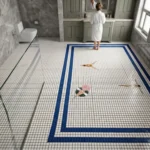
Border inlay: A mosaic border 15–30cm wide running along the perimeter of the bathroom, creating a defined “rug” effect. Borders in Greek key, guilloche, or custom geometric patterns provide visual structure without overwhelming the space.
Full-field mosaic floor: The entire bathroom floor covered in mosaic—most commonly 2×2cm or 2.5×2.5cm tesserae in a unified pattern. This approach works exceptionally well in smaller bathrooms (under 15 sq m), where a full mosaic floor eliminates grout-line visual clutter.
Slip resistance requirement: All bathroom floor mosaics must achieve DCOF ≥0.42 per ANSI A326.3. Specify textured glass, honed stone, or matte porcelain. Polished marble floors in bathrooms are a liability risk and should be avoided.
Vanity Backsplash & Mirror Surround
The vanity area is the most frequently viewed surface in the bathroom—occupants spend minutes facing it daily. A mosaic backsplash or mirror surround delivers maximum visual impact per square foot.
Design approaches:
- Full-height backsplash: Mosaic from countertop to ceiling behind the vanity, typically 60–90cm wide per sink. This creates a framed composition visible from across the room.
- Mirror frame: A 10–20cm mosaic border around a wall-mounted mirror, functioning as a permanent decorative frame. Gold or silver metallic tesserae work particularly well here, catching vanity lighting.
- Splash-only: A narrow (15–30cm height) mosaic band above the countertop, extending the full width of the vanity. This is the most cost-effective option while still delivering a custom finish.
Material guidance: Glass and metallic mosaics are ideal for backsplashes—they resist toothpaste, cosmetics, and cleaning products without staining. Avoid unsealed natural stone in splash zones.
Freestanding Tub Surround
The freestanding bathtub is the sculptural centerpiece of a luxury bathroom. A mosaic floor medallion or border beneath and around the tub anchors it within the space.
Design strategies:
- Tub platform mosaic: If the tub sits on a raised platform, cladding the platform riser in mosaic creates a visual pedestal effect.
- Floor inlay beneath tub: A circular mosaic composition centered under the tub, extending 30–60cm beyond the tub footprint on all sides.
- Wall mosaic behind tub: A vertical mosaic panel on the wall behind a freestanding tub creates a backdrop that frames the tub silhouette.
—
Installation Requirements for Wet Environments
Mosaic art in bathrooms must contend with conditions that wall and floor mosaics in dry areas never face: constant humidity, direct water spray, thermal cycling, and chemical exposure from cleaning products. Installation quality determines whether a luxury bathroom mosaic remains pristine for decades or fails within years.
Substrate Preparation
The substrate must be:
- Structurally sound: No deflection exceeding L/360 for ceramic/porcelain or L/720 for natural stone (per TCNA guidelines)
- Clean and contaminant-free: No curing compounds, form-release agents, paint, or adhesives
- Flat: Variation not exceeding 3mm in 3m (⅛” in 10 ft) for large-format mosaics; 1.5mm in 3m for glass mosaics
- Waterproofed: Continuous waterproof membrane across the entire wet zone, extending at least 150mm above the shower head and 100mm beyond the shower enclosure
Adhesive Selection
| Condition | Recommended Adhesive | Standard |
|—|—|—|
| Glass mosaic on waterproof membrane | Polymer-modified thin-set (latex or acrylic) | ANSI A118.4 |
| Glass mosaic on concrete backer board | White polymer-modified thin-set | ANSI A118.4 |
| Natural stone mosaic | White polymer-modified thin-set (prevents darkening through translucent stones) | ANSI A118.4 |
| Porcelain mosaic | Polymer-modified thin-set | ANSI A118.4 |
| Steam shower | Epoxy adhesive (zero moisture absorption) | ANSI A118.3 |
| Over radiant heating | Flexible polymer-modified thin-set | ANSI A118.4 + A118.12 |
Critical note: Always use white thin-set for glass mosaics. Gray thin-set will darken translucent and light-colored glass tesserae, altering the intended color appearance.
Grouting Protocol
For luxury bathroom mosaics, epoxy grout (ANSI A118.3) is the specification standard. Advantages over cementitious grout:
- Zero water absorption (no staining, no efflorescence)
- Chemical resistance (withstands acidic and alkaline cleaners)
- Color consistency (no shading variation between batches)
- 3× compressive strength of cement grout
Grout joint width: 1.5–3mm for glass and porcelain mosaics; 2–4mm for natural stone (accommodates irregular hand-cut edges). Wider joints reduce the mosaic’s visual cohesion; narrower joints increase the risk of grout bridging and cracking.
Color selection: Match grout to the dominant tile color for a seamless appearance. For patterned mosaics, a neutral gray (warm or cool depending on the palette) minimizes visual interruption. Avoid white grout in shower floors—it will discolor regardless of sealing.
Movement Joints
Per TCNA EJ171, install movement joints:
- At all perimeter intersections (wall-to-wall, wall-to-floor)
- Where mosaic meets dissimilar materials (large-format tile, stone slab)
- Every 6–8m in each direction for interior installations
- At changes in substrate plane
Fill movement joints with color-matched 100% silicone sealant, not grout. Grout in a movement joint will crack and allow water penetration.
Curing & Commissioning
After grouting:
1. Allow epoxy grout to cure per manufacturer specifications (typically 24–72 hours at ≥21°C)
2. Apply penetrating sealer to natural stone mosaics (after full grout cure)
3. Wait 7 days minimum before exposing to standing water (shower use)
4. Wait 28 days before hot-water exposure (steam shower) for full thin-set hydration
—
Cost Framework for Luxury Bathroom Mosaics
Understanding the cost structure of custom mosaic projects enables accurate budgeting and informed client conversations.
Cost Components
A luxury bathroom mosaic project has four cost components:
1. Material Cost — 30–50% of total
- Glass mosaic: $15–60/sq ft
- Marble/stone mosaic: $20–80/sq ft
- Porcelain mosaic: $8–25/sq ft
- Gold/metallic glass: $80–400/sq ft
- Smalti (artisan): $100–500/sq ft
2. Design & Customization — 10–20% of total
- Off-the-shelf pattern: $0 (standard catalog patterns)
- Color customization: $500–$2,000 (custom color matching to design palette)
- Custom pattern design: $1,500–$5,000 (original design, digital rendering, sampling)
- Full bespoke pictorial: $5,000–$20,000+ (artist-designed, hand-rendered, multiple sample rounds)
3. Installation — 35–50% of total
- Standard mosaic installation: $15–30/sq ft
- Complex pattern/medallion: $30–60/sq ft
- Artisan mosaic installation (smalti, pictorial): $60–150+/sq ft
- Premium modifiers: +20–30% for epoxy grout, +15–25% for crack-isolation membrane
4. Contingency — 10–15% of total
- Material overage (8–12% cutting waste minimum, 15%+ for complex patterns)
- Unforeseen substrate remediation
- Schedule buffer
Budget Scenarios
| Scope | Material | Design | Installation | Total (incl. 12% contingency) |
|—|—|—|—|—|
| Vanity backsplash (2 sq m), glass mosaic | $300–$1,300 | $0 (catalog) | $300–$600 | $700–$2,200 |
| Shower feature wall (6 sq m), glass + metallic accents | $1,500–$4,500 | $1,000–$3,000 | $1,800–$3,600 | $4,800–$12,400 |
| Full bathroom floor (12 sq m), marble mosaic medallion | $4,800–$19,200 | $2,000–$5,000 | $3,600–$7,200 | $11,600–$35,100 |
| Complete bathroom (15 sq m floors + 25 sq m walls), mixed materials | $12,000–$45,000 | $3,000–$8,000 | $10,000–$25,000 | $28,000–$87,400 |
Costs in USD, indicative. Actual pricing depends on material selection, site conditions, and regional labor rates.
—
Case Studies
Case Study 1: Presidential Suite Bathroom, Five-Star Hotel — Dubai
Project scope: Complete bathroom renovation (22 sq m) in a waterfront presidential suite. The design brief called for a bathroom that would “feel like bathing inside a jewel.”
Solution: BiliTiles produced a custom glass mosaic feature wall (4m × 2.7m) in graduating shades of sapphire blue to emerald green, with 24K gold glass tesserae interspersed at 5% density throughout the pattern. The floor featured a 2m-diameter marble mosaic medallion with Arabic geometric star patterns in Carrara white and Nero Marquina black marble.
Materials: Iridescent glass (85%), 24K gold glass (5%), Carrara marble (5%), Nero Marquina marble (5%)
Result: The bathroom became the hotel’s most-photographed interior space, generating an estimated $350K in earned media value within six months of opening. Suite occupancy rate: 92% at a $4,800/night ADR.
Case Study 2: Private Residence Master Bathroom — Bel Air, California
Project scope: 35 sq m master bathroom in a new-build contemporary residence. The client, a technology entrepreneur, wanted a “zero-gravity spa experience” with minimal visual clutter.
Solution: We designed a monochromatic mosaic floor (full-field, 2×2cm matte glass tesserae in three graduating gray tones) that transitions from dark charcoal at the bathroom entrance to pale silver-gray beneath the freestanding tub. The shower feature wall uses vertically oriented glass mosaic strips (5cm wide) in the same gray palette, creating a “rain” motif. No metallic elements—pure tonal restraint.
Materials: Matte glass mosaic in 3 custom gray tones (100%)
Result: The project was featured in Architectural Digest (March 2026). The homeowner reported a 15% property valuation increase attributed partly to the “magazine-quality bathroom.”
Case Study 3: Boutique Hotel Spa Bathrooms — Santorini, Greece
Project scope: 12 guest bathroom renovations in a cliffside boutique hotel. The brief required a design that referenced Cycladic architecture while meeting luxury hospitality durability standards.
Solution: Each bathroom received a custom shower floor mosaic in the hotel’s signature wave motif, using honed white Thassos marble and pale blue glass tesserae. The wave pattern is unique to each bathroom (12 variations), creating a sense of discovery for repeat guests. Vanity backsplashes feature a 15cm border of the same wave motif.
Materials: Thassos white marble (60%), pale blue glass (40%)
Result: “Room with the wave bathroom” became a specific booking request, increasing direct bookings by 18%. The hotel raised its average nightly rate by €120 (from €580 to €700) after the renovation, citing the unique bathroom design as a key differentiator.
—
Working with BiliTiles
If you are still evaluating materials and comparing options, start with our Complete Mosaic Tile Selection Guide for every room type and budget. BiliTiles operates a 3,000 sq m production facility in Foshan, China—the global center of ceramic and mosaic manufacturing. Our factory-direct model eliminates wholesaler and distributor markups, delivering custom mosaic art at 30–50% below equivalent Western European or North American production costs.
Our process:
1. Design consultation: Share your design brief, mood board, and dimensional drawings. Our in-house design team produces 2–3 concept renderings within 5 business days.
2. Material selection: We maintain 200+ glass colors and 50+ natural stone varieties in-stock, with custom color matching available.
3. Sampling: Physical sample sheets (30×30cm) produced and shipped within 10 business days for approval.
4. Production: Full production lead time of 4–8 weeks depending on complexity and volume.
5. Quality control: Every sheet inspected for color consistency, dimensional accuracy (±0.5mm tolerance), and pattern continuity before packaging.
6. Shipping: Air freight (5–7 days) or sea freight (25–35 days) to your project site. We handle all export documentation and customs clearance coordination.
7. Installation support: Detailed installation drawings, numbered sheet layout maps, and technical consultation throughout installation.
Certifications: ISO 9001:2015, CE (EN 14411), SGS-tested slip resistance and chemical resistance.
—
Conclusion
Mosaic art for luxury bathrooms represents the intersection of fine craft and architectural permanence. A well-designed mosaic bathroom does not date—it develops character. The investment in material quality, thoughtful design, and meticulous installation returns decades of daily enjoyment and a measurable property value premium.
Whether you are specifying a single vanity backsplash or designing a 50 sq m master bathroom suite, the principles remain the same: choose materials that perform in wet environments, design for the specific spatial context, and never compromise on installation quality.
Contact BiliTiles today to discuss your luxury bathroom mosaic project. Our design team will prepare complimentary concept renderings within 5 business days.
—
This guide was prepared by the BiliTiles design and engineering team. For technical specifications, MSDS documentation, or installation guides, contact our support desk at support@bilitiles.com.