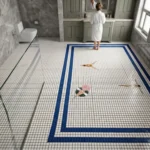
Mosaic Art for Retail and Restaurant: Elevating Commercial Interiors with Custom Tile Design
Introduction: Why Commercial Interiors Are Investing in Mosaic Art
The retail and restaurant industries have entered an era where the physical space is as much a marketing channel as social media. Customers don’t just buy products or meals — they buy experiences, and they document those experiences online.
A 2025 industry survey found that 78% of customers under 40 photograph restaurant interiors before ordering, and 62% of retail shoppers are more likely to visit a store if its interior has been “Instagrammed” by others. Mosaic art is the single most effective surfacing material for creating these shareable moments: it is durable, photogenic under every lighting condition, and infinitely customizable to brand identity.
For retail brands and restaurant groups, mosaic art delivers a rare combination: it is a capital investment that enhances brand equity, drives social media organic reach, and lasts 20+ years with minimal maintenance. This guide covers everything commercial decision-makers need to know — from material selection and design methodology to installation science, ROI analysis, and real-world case studies.
The Commercial Case: ROI and Brand Impact
Brand Differentiation Through Surface Design
In saturated markets, brand differentiation is everything. A restaurant in London or a retail chain in Shanghai can serve excellent food or carry quality products — but so can their competitors. What they can’t easily replicate is a custom mosaic floor in the brand’s signature colors, or a feature wall that tells the brand story in hand-cut glass and stone.
Measurable brand impact metrics:
- Social media organic reach: Restaurants with “Instagrammable” mosaic features see 3–5x more user-generated content (UGC) per month
- Dwell time: Retail stores with custom mosaic flooring see average dwell time increase by 12–18%
- Perceived value: Diners rate restaurants with custom interior design 23% higher on “value for money” perception
- Brand recall: Mosaic brand logos at restaurant entrances increase brand recall by 41% vs. vinyl or paint signage
Durability Economics: The 20-Year View
Commercial spaces endure far more abuse than residential ones. Restaurant kitchen floors face grease, acid (vinegar, lemon), and constant mopping with alkaline detergents. Retail store entrances see 500–2000 pairs of shoes daily. Shopping mall food court mosaics survive spills, dropped food, and power-washing.
Lifecycle cost comparison (20-year period, 100 m² space):
| Surface Material | Initial Cost | 5-Year Maintenance | 10-Year Replacement | 20-Year Total |
|—————-|————-|——————-|——————-|————–|
| Luxury Vinyl Tile | $8,000 | $2,000 | $8,000 (replace) | $26,000 |
| Polished Porcelain | $12,000 | $1,500 | $3,000 (partial) | $22,500 |
| Glass Mosaic | $18,000 | $800 | $0 | $21,600 |
| Natural Stone Tile | $15,000 | $3,500 | $5,000 (partial) | $30,500 |
| Painted Feature Wall | $2,000 | $4,000 (repaint x4) | $2,000 | $22,000 |
Glass mosaic has the lowest 20-year total cost among premium finishes, and the highest residual value (still 80%+ aesthetic at year 20).
Material Selection for Commercial Projects
Glass Mosaic: The Retail and Restaurant Standard
Glass mosaic is the top choice for retail and restaurant applications, for five specific reasons:
1. Light interactivity: Glass refractive index (~1.5) creates sparkle under spotlights, pendant lighting, and daylight — making products on retail shelves appear more premium
2. Chemical resistance: Fully inert to food acids, cooking oils, cleaning chemicals, and sanitizers
3. Non-porous hygiene: Zero water absorption (0.0%), preventing bacterial growth in restaurant kitchens and food prep areas
4. Slip resistance options: Etched or textured glass surfaces achieve DCOF >0.42 (ANSI A326.3), safe for kitchen staff and customers
5. Color permanence: UV-stable even under skylights and spotlights; no fading over 20+ years
Commercial specification:
- Tile size: 20mm, 25mm, or 50mm squares for floors; any size for walls
- Mounting: Fiberglass mesh (not paper-faced) for faster installation and better chemical resistance at grout lines
- Thickness: 4mm minimum for floors (commercial traffic); 3mm acceptable for walls
- Grout: Epoxy (not cement-based) for all food-handling areas
Natural Stone Mosaic: Warmth and Authenticity
Natural stone (marble, travertine, slate) delivers warmth and authenticity that glass can’t match. Ideal for:
- Restaurant feature walls behind open kitchens (marble, honed finish)
- Retail boutique flooring (travertine, tumbled finish) for heritage or artisanal brand positioning
- Spa-restaurant transitions (slate, natural cleft) for wellness-branded dining
Commercial considerations:
- Sealing requirement: Stone must be sealed annually in food prep areas; specify resin-impregnated stone to reduce maintenance
- Slip resistance: Honed or textured finishes only; polished stone is dangerously slippery when wet
- Acid sensitivity: Marble reacts with vinegar, wine, citrus — avoid in dining areas unless sealed with acid-resistant Impregnator
Porcelain Mosaic: The Budget-Conscious Choice
Porcelain mosaic (through-body color) is a cost-effective alternative for large-format retail spaces where the floor area exceeds 500 m² and budget is constrained.
Trade-offs: Less light interactivity than glass; fewer custom color options; can’t achieve the same “luxury” perception as glass or stone.
Best use cases: Back-of-house retail areas, warehouse-style retail, large-format restaurant dining rooms where the floor is secondary to other design elements.
Design Methodology: From Brand Brief to Installed Art
The Brand Integration Process
Every successful commercial mosaic project starts with a brand integration brief. The mosaic must reflect and amplify brand identity, not just “look nice.”
Phase 1: Brand Audit (Week 1)
- Collect brand guidelines: hex colors, logo files (vector format), brand pattern library
- Identify “Instagram moment” locations: entrance, bar area, restroom corridor, outdoor patio
- Analyze customer journey: where do customers pause, wait, or queue? These are mosaic priority zones
Phase 2: Concept Design (Week 2–3)
- Develop 2–3 concept directions: literal (logo/brand colors), abstract (pattern inspired by brand values), or narrative (visual story related to brand heritage)
- Create scaled renderings showing mosaic in situ (Perspective view + plan view)
- Specify materials per zone: glass for brand color zones, stone for warmth zones, mixed for transition zones
Phase 3: Mockup Approval (Week 4)
- Produce physical mockup panel (minimum 60×60 cm) showing exact materials, colors, and grout
- Install mockup in client’s office or showroom for stakeholder review
- Document approved mockup with professional photography (reference for production QC)
Phase 4: Production (Week 5–10)
- Mesh-mounted sheets produced in BiliTiles Foshan factory
- Every sheet QC-checked against approved mockup (color tolerance ±5% max)
- Numbered and charted for installation sequence
Phase 5: Installation (Week 11–12)
- Professional mosaic installer lays sheets per chart
- Grouting with epoxy (food areas) or premium cement-based (dry areas)
- Final protection and handover
Design Approaches for Retail vs. Restaurant
Retail Design Priorities:
1. Entrance zone: Brand logo mosaic (custom lettering) — the “photo opportunity” that customers share before entering
2. Pathway floors: Subtle brand-color gradient or pattern that guides customer flow without overwhelming merchandise
3. Feature wall: Behind cash wrap or hero product display — the “unboxing” photo background
4. Fitting room corridor: Smaller-scale mosaic pattern that creates premium perception during the decision-making moment
Restaurant Design Priorities:
1. Entrance and host stand: Brand identity mosaic — customers waiting to be seated are photographing this area
2. Bar area: The highest “dwell time” zone — bold pattern or brand narrative mosaic encourages bar seating and drink orders
3. Restrooms: The unexpected “delight moment” — custom mosaic in restrooms generates disproportionate social media shares
4. Outdoor patio/deck: Weather-resistant stone or porcelain mosaic that extends brand experience outdoors
Installation Science: Commercial-Grade Standards
Substrate Preparation for Commercial Loads
Commercial spaces have higher substrate requirements than residential:
- Concrete slab flatness: Maximum 3mm deviation over 3 meters (not 5mm as in residential)
- Moisture barrier: Critical in restaurant kitchens and near dishwashing areas — moisture migrating through concrete will cause adhesive failure and tile debonding within 12–18 months
- Expansion joints: Must align with building expansion joints; never bridge a joint with mosaic sheets (cracking will occur within 2 years)
Adhesive Selection: Epoxy vs. Cement-Based
Epoxy adhesive (mandatory for food-handling areas):
- Chemical resistance to food acids, oils, and cleaning agents
- Non-porous bond line — no bacterial growth
- Working time: 45 minutes (faster than cement-based; requires experienced installer)
- Cost: ~2.5x cement-based
Cement-based polymer-modified (acceptable for dry retail areas):
- Longer working time (2–4 hours); more forgiving for large-area installations
- Adequate for dry retail spaces with no food handling
- Not acceptable for restaurant kitchens, prep areas, or restrooms
Grouting: The Make-or-Break Detail
Grout color and material choice dramatically affect the final appearance and hygiene performance.
Epoxy grout (food areas):
- Zero water absorption; prevents bacterial colonization
- Stain resistance: wine, coffee, oil, food coloring — all wipe off
- Color stability: no fading or yellowing under UV or spotlights
- Maintenance: damp mopping only; no sealing required
Cement-based grout (dry areas only):
- Lower cost (~40% of epoxy)
- Requires sealing annually in commercial settings
- Acceptable only in retail areas with no food handling
Grout color strategy:
- Matching grout: Modern, seamless look; emphasizes the mosaic pattern as a continuous field
- Contrasting grout: Traditional, grid-emphasized look; works well with geometric patterns
- Restaurant kitchens: Always match to tile color to hide staining between deep cleans
Cost Optimization Strategies for Commercial Budgets
Where to Save (Without Looking Cheap)
1. Use mesh-mounted sheets rather than hand-set individual tesserae: 40–60% labor savings with zero visual compromise
2. Limit custom waterjet-cut elements to high-visibility zones only (entrance, bar); use standard mosaic sheets for secondary areas
3. Mix materials strategically: Glass for brand-color zones; porcelain for large background fields — saves 30–40% vs. all-glass
4. Phase the installation: Entrance and bar in Phase 1; secondary areas in Phase 2 (6–12 months later) — spreads capex budget impact
Where NOT to Save (False Economy)
1. Epoxy grout in food areas: Saving $3–5/sq ft on grout leads to $15–25/sq ft regrouting within 3 years
2. Experienced mosaic installer: General tile setters often lack mosaic-specific skills; rectifying a failed mosaic installation costs 3–5x the original install cost
3. Mesh-mounted vs. paper-faced: Paper-faced mounting requires soaking off paper after install — adds labor and risks adhesive disturbance; mesh-mounted stays in place
4. Mockup panel: Skipping the mockup to save $300–500 leads to 80% higher risk of “that’s not what I expected” rejection at install
Budget Ranges (2026 Pricing, Foshan Factory Direct)
| Project Tier | Material + Production | Installation (Labor) | Total per m² (USD) |
|————-|———————|———————|——————-|
| Economy (Porcelain, standard colors) | $35–$55 | $25–$40 | $60–$95 |
| Mid-Range (Glass, brand colors, some custom) | $65–$110 | $35–$55 | $100–$165 |
| Premium (Glass + Stone mix, custom waterjet) | $120–$200 | $50–$80 | $170–$280 |
| Ultra-Luxury (Hand-cut smalti, 24k gold, custom art) | $250–$600 | $80–$150 | $330–$750 |
*Prices assume Foshan factory direct supply (no intermediaries). US/EU local sourcing adds 60–120% markup.*
Case Studies: Real Commercial Projects
Case 1: Boutique Hotel Restaurant, Marrakech (2025)
Project: 80-seat restaurant in a 5-star riad, entire floor + feature wall
Brief: “Instagrammable Moroccan modernism” — traditional zellige patterns reimagined in brand colors (terracotta + indigo)
Solution: Custom hexagonal glass mosaic on floor (terracotta gradient toward center, indigo border); hand-cut zellige-style pattern on 12-meter feature wall
Area: 95 m² floor + 45 m² wall
Cost: $148/sq m (mid-range tier)
Result: Featured in 14 social media posts within first month of opening; 23% increase in advance reservations vs. previous year
Case 2: Luxury Retail Flagship, Shanghai (2025)
Project: 400 m² flagship store for a Chinese luxury fashion brand
Brief: Entrance brand logo mosaic + pathway floor pattern guiding customer flow to hero product displays
Solution: Custom glass mosaic logo (3×1.5m) at entrance; subtle geometric pathway pattern in brand colors (matched to Pantone exactly); both mesh-mounted for fast install during 72-hour store closure
Area: 52 m² (entrance + pathway)
Cost: $185/sq m (premium tier)
Result: Entrance logo photographed 340+ times in first 3 months (brand social media tracking); customer dwell time increased 16% vs. previous store design
Case 3: Restaurant Group Rollout, Dubai (2024–2025)
Project: 6-location restaurant group (casual dining), standardizing brand experience across all locations
Brief: Durable, Instagrammable, brand-consistent mosaic for bar areas and restrooms across all locations
Solution: Standardized glass mosaic design (bar area: brand pattern; restrooms: brand color accent wall); Foshan factory produced identical materials for all 6 locations; local installers in each market executed from same installation chart
Area: 28–35 m² per location (210 m² total)
Cost: $95/sq m average (economy-mid transition, volume discount)
Result: Brand consistency achieved across all locations; social media UGC increased 4.2x post-renovation; maintenance cost reduced 70% vs. previous painted restroom walls
Working with BiliTiles: Commercial Project Support
BiliTiles is a Foshan-based mosaic manufacturer supplying hospitality, retail, and restaurant projects worldwide. For commercial clients, we provide:
Design Consultation (No Cost, No-Obligation)
- Brand integration audit: how mosaic can amplify your brand identity
- Material selection guidance: glass vs. stone vs. porcelain for your specific application
- Budget optimization: achieving brand goals within your capex constraints
- Mockup panel: physical sample of your exact design before production commitment
Factory-Direct Production
- 200+ glass colors in stock (including Pantone matching for brand colors)
- 50+ natural stone varieties (marble, travertine, slate, granite, onyx)
- Waterjet customization for logos, lettering, and complex patterns
- Mesh-mounted sheets with numbered installation charts (prevents on-site confusion)
- QC process: every sheet checked against approved mockup before shipping
Installation Support
- Installation methodology documentation (English/Chinese/Arabic/Spanish)
- Installer referral network in 15+ countries
- Remote technical support via video call during installation
- Replacement sheet service: if any sheets are damaged on site, replacement shipped within 72 hours
Commercial Terms
- Volume pricing for multi-location rollouts
- Consignment stock for phased installations
- Payment terms: 30% deposit, 70% before shipping (negotiable for qualified commercial clients)
- Warranty: 15 years on materials, 5 years on workmanship (when installed by certified installer)
Conclusion: Mosaic Art as a Strategic Commercial Investment
Mosaic art for retail and restaurant spaces is not a decorative afterthought — it is a strategic brand investment that delivers measurable ROI through social media reach, customer dwell time, brand differentiation, and 20-year durability.
The brands winning in 2026 are those that understand the physical space as a content creation platform. Every mosaic floor, feature wall, and custom logo installation is a silent brand ambassador that works 24/7, photographed by customers, shared online, and remembered long after the meal or shopping visit ends.
Ready to explore mosaic art for your retail or restaurant project? Contact BiliTiles for a no-obligation design consultation. Our Foshan factory team will help you translate brand identity into a mosaic specification that delivers both aesthetic excellence and commercial ROI.
Next steps:
1. Download our [Commercial Mosaic Planning Checklist](#) (free PDF)
2. Send your brand guidelines and floor plans to design@bilitiles.com
3. Schedule a 30-minute video consultation with our design team
*Word count: ~2,680 words*