# Natural Stone Mosaic: A Complete Guide to Materials, Design, and Installation
**Meta description:** Discover everything about natural stone mosaic — from travertine and marble to slate and granite. Learn how to choose, design, install, and maintain stone mosaic tiles for floors, walls, and outdoor spaces.
**Focus keyword:** natural stone mosaic
—
## Why Natural Stone Mosaic Is a Timeless Choice
When designers and homeowners want surfaces that feel organic, durable, and genuinely beautiful, natural stone mosaic consistently rises to the top of the spec list. Unlike ceramic or glass alternatives, each stone mosaic sheet carries unique tonal variation — no two panels are identical. That authenticity is impossible to replicate with printed tiles.
Natural stone mosaic also delivers a tactile quality that photography rarely captures well. Running your hand over a field of tumbled travertine or split-face slate reveals texture that adds depth to any interior or exterior surface. For architects working on hospitality projects, healthcare facilities, or high-end residential interiors, stone mosaic offers a material story that clients respond to viscerally.
This guide covers everything you need to know: stone types and their characteristics, mosaic formats and mounting systems, design applications across rooms and outdoor areas, proper installation technique, and a maintenance routine that keeps stone looking its best for decades.
—
## Stone Types Used in Natural Stone Mosaic
### Marble Mosaic
Marble is the most widely specified stone in high-end mosaic applications. Its crystalline structure takes a polish exceptionally well, producing the luminous surface that defines luxury interiors. Common formats include honed (matte) and polished finishes, and tile sizes range from 1×1 inch to 3×3 inches.
**Best applications:** Bathroom walls and floors, entryway floors, fireplace surrounds, kitchen backsplashes.
**Considerations:** Marble is calcium carbonate-based, which makes it sensitive to acidic substances — wine, citrus juice, and many cleaning products will etch the surface if not wiped promptly. For kitchen counters, a proper sealer and immediate cleanup are non-negotiable. For bathroom and backsplash use, marble performs well with routine sealing every 12–18 months.
### Travertine Mosaic
Travertine is a sedimentary limestone formed by hot mineral springs. It has a distinctive porous structure — sometimes filled with grout during production and sometimes left with natural voids for a more rustic look. Travertine comes in several finishes: honed (filled and smoothed), tumbled (soft edges, unfilled), and brushed (textured surface).
**Best applications:** Outdoor patios and pool decks, bathroom floors, hallway floors, accent walls.
**Considerations:** Travertine is freeze-thaw stable when properly sealed, making it one of the better natural stone options for exterior use in colder climates. The unfilled (“cross-cut”) variant looks stunning outdoors but will collect dirt in the voids without regular pressure washing. The filled-and-honed variant is lower maintenance for high-traffic floors.
### Slate Mosaic
Slate is a foliated metamorphic rock — meaning it splits naturally into relatively flat sheets. This gives slate mosaic tiles a naturally uneven surface that provides excellent slip resistance, even when wet. Colors range from deep charcoal and graphite to variegated purple, green, and rust tones depending on the quarry origin.
**Best applications:** Outdoor walkways, pool decks, mudroom floors, basement floors, feature walls.
**Considerations:** Some slate products contain iron sulfide, which can leach out and cause rust staining if the stone gets wet repeatedly. Always verify with your supplier that the slate is “sound” (iron sulfide-free) before specifying for wet-area outdoor use. Testing a small sample with prolonged water contact for 48 hours is a worthwhile precaution.
### Granite Mosaic
Granite is an igneous rock — extremely hard, dense, and resistant to scratching and staining when properly sealed. While most granite is used in large-format slabs for countertops, mosaic applications in granite are available in polished, flamed, or leathered finishes.
**Best applications:** Kitchen backsplashes, accent walls, high-traffic commercial floors, outdoor kitchen surfaces.
**Considerations:** Granite mosaic is significantly more expensive than marble or travertine. The material weight is also higher, which affects transportation and installation costs. For most residential projects, a polished granite mosaic border or inset paired with a larger-format porcelain field tile delivers the design impact at a more manageable cost.
### Onyx Mosaic
Onyx is a banded variety of chalcedony (a microcrystalline quartz). Its translucent quality allows backlighting applications that no other natural stone can replicate. Onyx is relatively soft (Mohs hardness 6–7) and highly sensitive to acids, but in low-wear decorative applications, its visual drama is unmatched.
**Best applications:** Feature walls in bars and restaurants, bathroom accent panels, backlit stone panels, decorative insets.
**Considerations:** Onyx should not be specified for floors or high-wear surfaces. Its primary value is in vertical applications where its translucency and banding patterns can be appreciated. Sealing with a penetrating sealer is mandatory, and acidic cleaners must be strictly avoided.
—
## Mosaic Formats and Mounting Systems
Understanding the difference between mounted and unmounted mosaic is essential for accurate specification and installation planning.
### Mesh-Mounted Mosaic Sheets
The standard format for most stone mosaic products. Individual tiles are adhered to a fiberglass mesh backing in sheets, typically 12×12 inches or 12×24 inches. The mesh holds tiles at consistent grout joint spacing (usually 1/16 inch or 2mm) and simplifies handling on walls and floors.
**Advantage:** Faster installation, consistent joint spacing, easier handling of small tiles.
**Disadvantage:** The mesh must be removed or adequately embedded — if the adhesive beneath the mesh does not bond to the substrate, the mesh can become a bond-breaker rather than a bond-enhancer.
### Paper-Faced Mosaic
Individual tiles are temporarily mounted face-up on paper sheets. During installation, the paper is soaked off after the adhesive sets. This format eliminates any risk of mesh interference with bonding.
**Advantage:** Superior bond between stone and substrate, no mesh-related delamination risk.
**Disadvantage:** Slower installation, requires more installer skill and attention.
### Unmounted Loose Tile
Individual tiles without any backing, requiring the installer to set each tile individually. This is the traditional format used by craftspeople creating intricate patterns on-site.
**Advantage:** Maximum design flexibility for custom patterns and inlays.
**Disadvantage:** Significantly higher labor cost, requires highly skilled craftspeople, slow.
—
## Design Applications by Room
### Bathroom: Stone Mosaic Floors and Walls
Stone mosaic in bathrooms must balance three competing demands: water resistance, slip resistance, and aesthetic warmth.
**Recommended formats:** Travertine tumbled mosaic for floors (natural texture provides grip), honed marble 1×1 or 2×2 mosaic for walls, slate mosaic as a feature panel behind the bathtub.
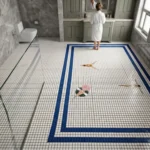
**Design tip:** A stone mosaic floor with a contrasting stone tile border creates a visual “room within a room” effect. For example, 12×24 inch honed travertine field tile with a 6×6 inch marble mosaic border and inset corner medallion delivers luxury without visual noise.
**Sealing schedule:** Floors should be sealed before grouting (penetrating sealer), then sealed again after grout cure. Annual resealing with a quality stone sealer prevents moisture penetration that leads to efflorescence and mold.
### Kitchen: Backsplash and Accent Walls
Stone mosaic as a kitchen backsplash is a perennial favorite, but the material choice matters enormously here because of exposure to cooking oils, acidic foods, and frequent cleaning.
**Recommended formats:** Polished marble mosaic for design impact (requires sealing commitment), granite mosaic for durability without the maintenance overhead of marble, travertine filled-and-honed for a warmer, more casual aesthetic.
**Design tip:** Extend the mosaic backsplash 4 inches up from the counter and full height behind the cooktop. Using a smaller mosaic format (1×1 or 2×2) near the cooktop and transitioning to larger field tile above creates visual hierarchy and reduces the cleaning burden — smaller grout lines near splatter sources catch grease faster.
### Outdoor: Patios, Pool Decks, and Garden Paths
Outdoor stone mosaic demands the most rigorous material selection. Freeze-thaw cycles, UV exposure, standing water, and biological growth (algae, moss) all attack stone surfaces in ways that indoor applications do not.
**Recommended formats:** Tumbled travertine for pool decks (the natural voids drain water and provide grip; the soft edges reduce injury risk from falls), split-face slate for garden path accents, granite flamed mosaic for outdoor kitchen surfaces.
**Critical installation note:** Outdoor stone installations require a minimum 1/4 inch per foot slope away from structures to promote drainage. Standing water on stone mosaic grout joints accelerates efflorescence and biological growth. A properly sloped substrate also prevents ice-related tile displacement in winter.
### Commercial Spaces: Hospitality and Retail
Natural stone mosaic in commercial lobbies, corridors, and feature walls creates a material statement that clients and visitors read immediately as quality. The investment is justified by the permanence effect — stone surfaces do not show wear in the same way that wood or carpet does.
**Recommended applications:** Marble mosaic lobby floor medallions and border strips, travertine mosaic bathroom walls in upscale hotels, slate mosaic bar backs in craft breweries and wine bars.
**Project specification tip:** For commercial projects, require a stone mockup panel (minimum 24×24 inches) showing the selected stone in the proposed finish before committing to the full installation. Stone is a natural material — color and texture variation is not a defect, but it must be within an acceptable range that is agreed upon before fabrication.
—
## Installation: Professional Standards for Stone Mosaic
Even the finest natural stone mosaic will fail prematurely if installation technique is poor. Here are the critical checkpoints that separate lasting installations from callbacks.
### Substrate Preparation
Stone mosaic weighs 3–6 lbs per square foot depending on thickness. The substrate must be rigid and deflection-free. For floor applications, the subfloor deflection must meet L/720 criteria (floor joist deflection under live load must be less than 1/720 of the span).
**Subfloor preparation sequence:**
1. Verify substrate flatness: maximum 1/4 inch deviation over 10 feet
2. Apply crack isolation membrane for substrates with any history of cracking or for ground-floor concrete over fill
3. Prime with a suitable primer for the adhesive system in use
### Adhesive Selection
Natural stone mosaic requires modified thinset mortar — never standard (unmodified) thinset, and never mastic (organic adhesive). Modified thinset contains latex polymers that improve bond strength and flexibility, which is essential for the differential thermal movement that stone experiences that ceramic does not.
For exterior installations and wet areas, use a highly modified (ISO 13007 classification C2S1 or C2S2) thinset. For interior dry areas, C1 or C2 classification is sufficient.
**Color-matched adhesive:** For translucent stone types (some marble, onyx), use white thinset rather than gray to prevent color bleed-through that changes the stone’s apparent tone.
### Grout Selection and Technique
For natural stone mosaic with 1/16 inch joints, unsanded grout is typically specified. For joints wider than 1/8 inch, sanded grout prevents excessive shrinkage cracking.
**Grout color strategy:** For a clean, modern look, use a grout color that matches or slightly lightens the stone’s predominant tone. A very dark grout with light stone creates a high-contrast “grid” effect that reads as more contemporary. A grout color very close to the stone creates a unified surface and reads as more organic and calm.
**Epoxy grout consideration:** For bathrooms and wet areas, epoxy grout eliminates water penetration in grout joints entirely. It is more difficult to install and more expensive, but the long-term maintenance reduction (no sealing of grout lines) is significant. Stone sealer still applies to the stone face, but the grout joints are inherently waterproof.
### Expansion and Movement Joints
Stone and grout expand and contract with temperature change. A 50-linear-foot run of stone mosaic will expand approximately 1/4 to 3/8 inch over a 100°F seasonal temperature swing. This movement must be accommodated with expansion joints at perimeters, transitions, and intervals of no more than 25 feet in exterior installations.
**Expansion joint specification:** Pre-compressed foam backup rod to 1/3 joint depth, topped with a urethene or silicone sealant in a color that matches or complements the grout. Never fill expansion joints with grout — it will crack.
—
## Maintenance and Care
### Routine Cleaning
For daily or weekly cleaning, use a pH-neutral stone cleaner or a few drops of mild dish soap in warm water. Avoid vinegar, ammonia, bleach, and acidic bathroom cleaners — all will degrade stone sealers and etch calcium carbonate stones.
**Cleaning frequency:** Floors in high-traffic areas benefit from dust mopping or vacuuming every 1–2 days. Wet-mop with stone cleaner weekly. Bathroom stone walls should be squeegeed after each use and cleaned with stone cleaner every 2–4 weeks.
### Sealing
Penetrating (impregnating) stone sealers work by filling the pores below the stone surface without changing its appearance. They prevent staining from water-borne and oil-borne substances without altering the stone’s look or feel.
**Sealer application frequency:** Interior stone floors and walls typically need resealing every 12–24 months depending on traffic and cleaning frequency. Test sealing effectiveness by placing a few drops of water on the stone surface — if the water darkens the stone within 30 minutes, resealing is needed. If it beads on the surface, the sealer is still effective.
**Application process:**
1. Clean the surface thoroughly and allow to dry completely (24–48 hours for dense stone, 48–72 hours for more porous travertine)
2. Apply sealer with a paint pad or low-nap roller, working in sections
3. Allow sealer to absorb for 10–15 minutes, then wipe off excess with a clean, dry cloth
4. Allow 24 hours cure time before allowing foot traffic or water contact
### Stain Removal
**Oil stains:** Apply a Poultice powder (available at stone supply distributors) mixed with acetone or mineral spirits to the stain. Cover with plastic wrap and tape edges. Allow 24–48 hours, then scrape off and clean. For persistent stains, repeat.
**Organic stains (mold, algae):** Mix 1/2 cup hydrogen peroxide (3% strength from any pharmacy) with 1 tablespoon of ammonia-free dish soap. Apply to stained area, allow 10 minutes, scrub gently, rinse with clean water. Do not mix hydrogen peroxide with bleach — this creates dangerous gases.
**Rust stains from iron-bearing stone:** Poultice with a commercial rust remover poultice powder. Do not use muriatic acid — it will etch the stone surface severely.
—
## Cost Considerations and Budget Planning
Natural stone mosaic pricing varies significantly based on stone type, origin, finish, and format. Here is a general market range for reference (prices in USD per square foot, approximate for mesh-mounted 12×12 sheets):
| Stone Type | Material Cost/sq ft | Installation Cost/sq ft | Total Installed |
|————|———————|————————–|—————–|
| Travertine tumbled | $4–$8 | $8–$14 | $12–$22 |
| Marble honed/polished | $8–$18 | $10–$18 | $18–$36 |
| Slate split-face | $6–$12 | $8–$14 | $14–$26 |
| Granite polished | $10–$20 | $12–$20 | $22–$40 |
| Onyx | $18–$35 | $14–$22 | $32–$57 |
These ranges assume standard 12×12 mesh-mounted sheets. Custom patterns (inlaid medallions, custom color blends, paper-faced installation) can run 2–4× these figures.
**Budget tip:** Consider stone mosaic as an accent element rather than wall-to-wall flooring. A mosaic border, corner inset, or feature wall panel uses less material while creating a strong design statement. Pair stone mosaic accents with large-format porcelain or ceramic field tile for a cost-effective project that hits high-end design notes without six-figure material bills.
—
## Sourcing and Quality Verification
Not all natural stone mosaic products are created equal. Quality depends on quarry source, fabrication precision, and grading standards.
**What to verify with your supplier:**
– Consistency of thickness across tiles (excessive thickness variation makes it impossible to achieve a flat installation)
– Mesh adhesion quality (tiles should not fall off the mesh during handling)
– Color and texture batch consistency (order all material for a project from the same production lot; stone varies by quarry face and season)
– Whether the stone has been pre-sealed at the factory or requires sealing on-site
– Country of origin and any associated import duties or logistics lead times
**Recommended sourcing for North American projects:** Request samples before placing orders. Legitimate stone distributors will provide 12×12 sample sheets at cost or no charge. Reputable suppliers will also provide material data sheets confirming the stone’s absorption rate, density, and flexural strength — all relevant to exterior and wet-area specification.
—
## Conclusion
Natural stone mosaic stands apart from synthetic tile alternatives because it is genuinely irreplaceable. No manufacturing process replicates the geological history embedded in each piece of marble, travertine, slate, or granite. That authenticity, combined with a range of stone types, formats, and finishes that spans every design aesthetic from rustic to ultra-contemporary, makes stone mosaic one of the most versatile high-end surface materials available.
The key to a successful stone mosaic installation is matching the right stone to the application environment, specifying proper installation materials and technique, and committing to a maintenance routine that protects the investment. Done correctly, a natural stone mosaic surface will outlast the building it occupies.
**Word count: ~2,450**